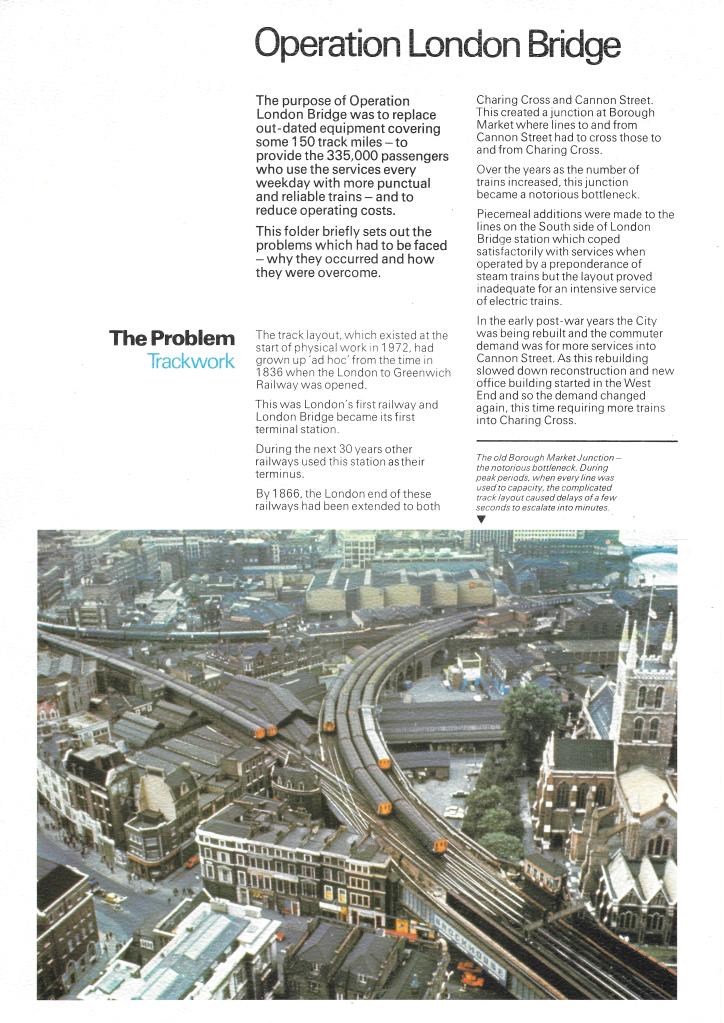
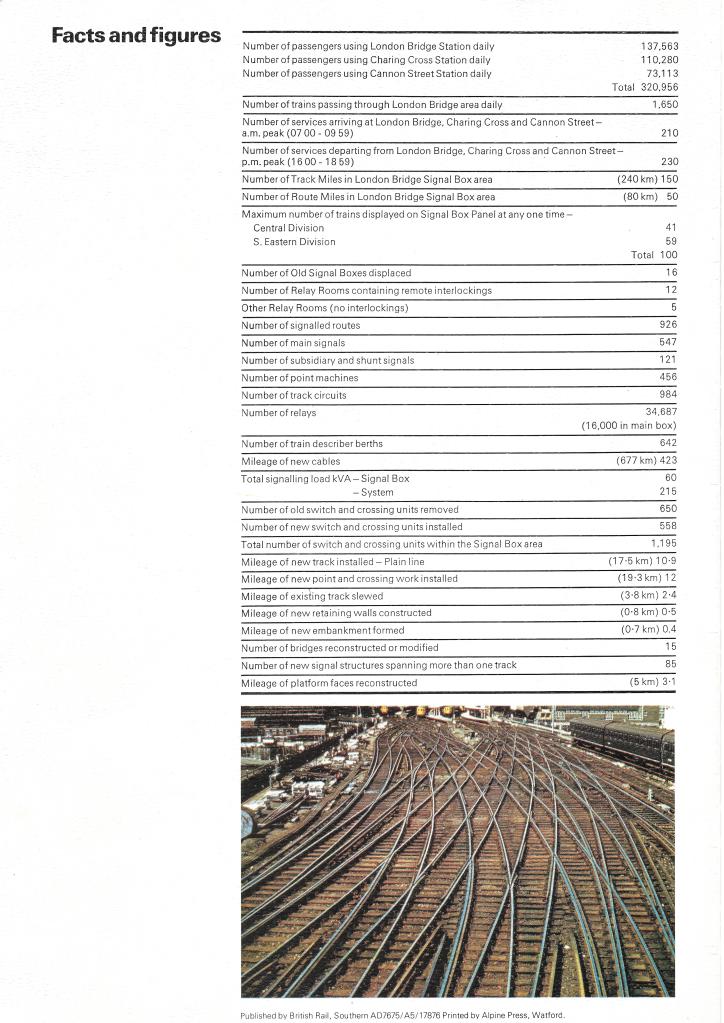
Before the re-imagining of London Bridge station in the 2010’s, it was the subject of a huge re-signaling scheme in the mid 1970’s. The idea was to completely redesign the approach, especially across Borough Market Junction. This was a notorious bottleneck where trains from Charing Cross and Cannon Street, as well as approaching traffic from Kent and Sussex would almost always grind to a halt at peak times.
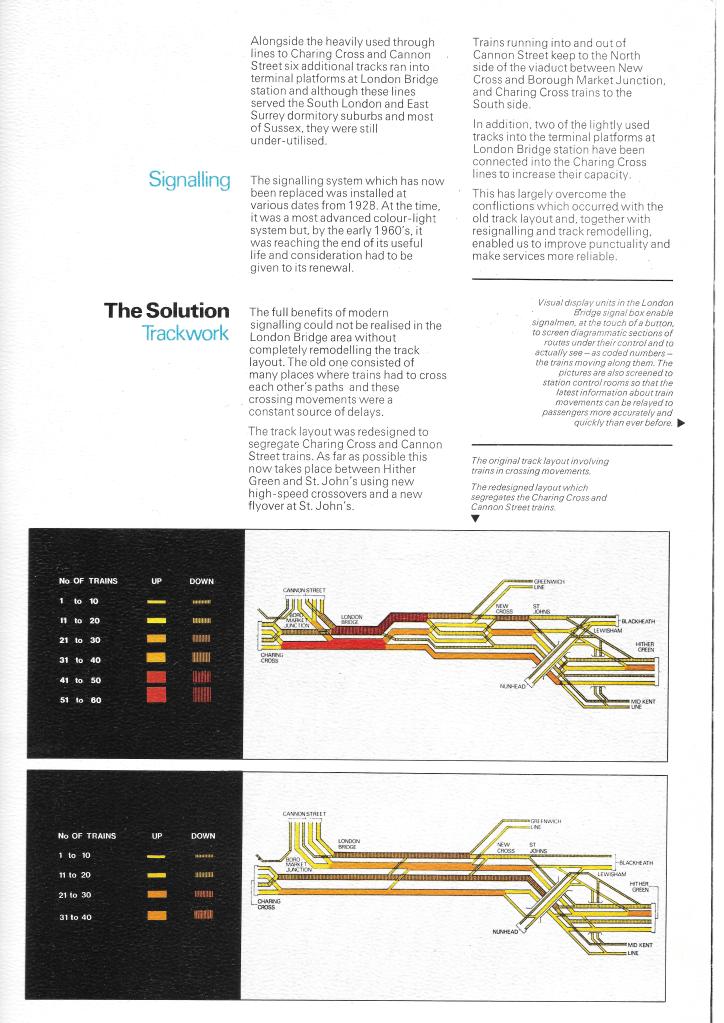
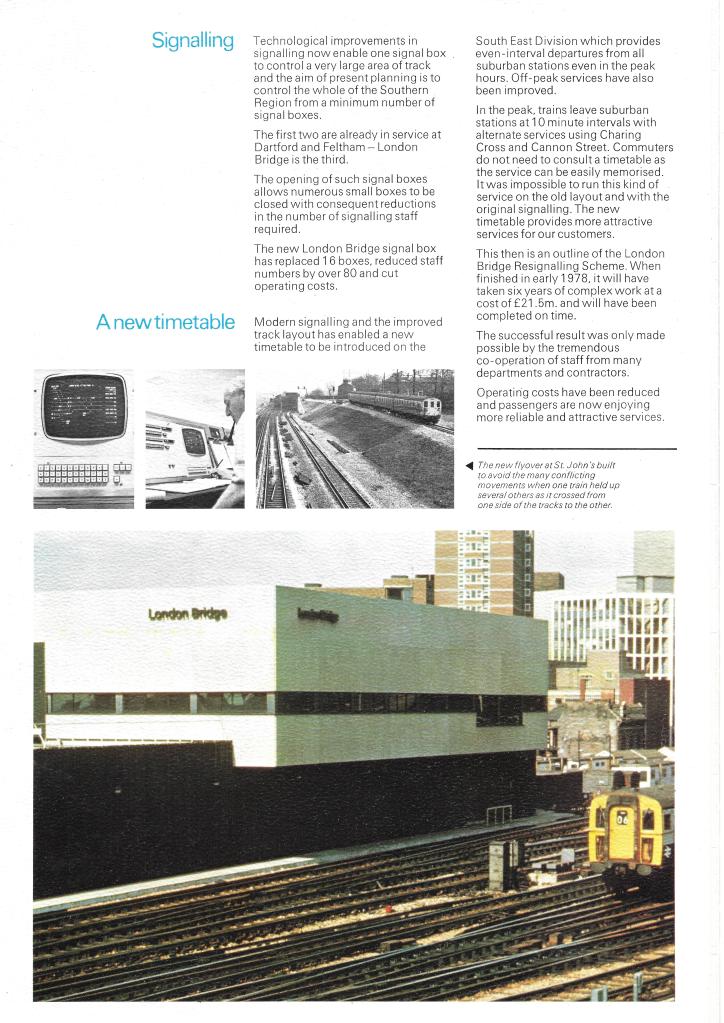
The solution was to create more throughput by using crossovers from Charing Cross and Cannon Street and using a new flyover at St Johns. Some terminal platforms were also connected to the Charing Cross lines in order to facilitate more throughput.
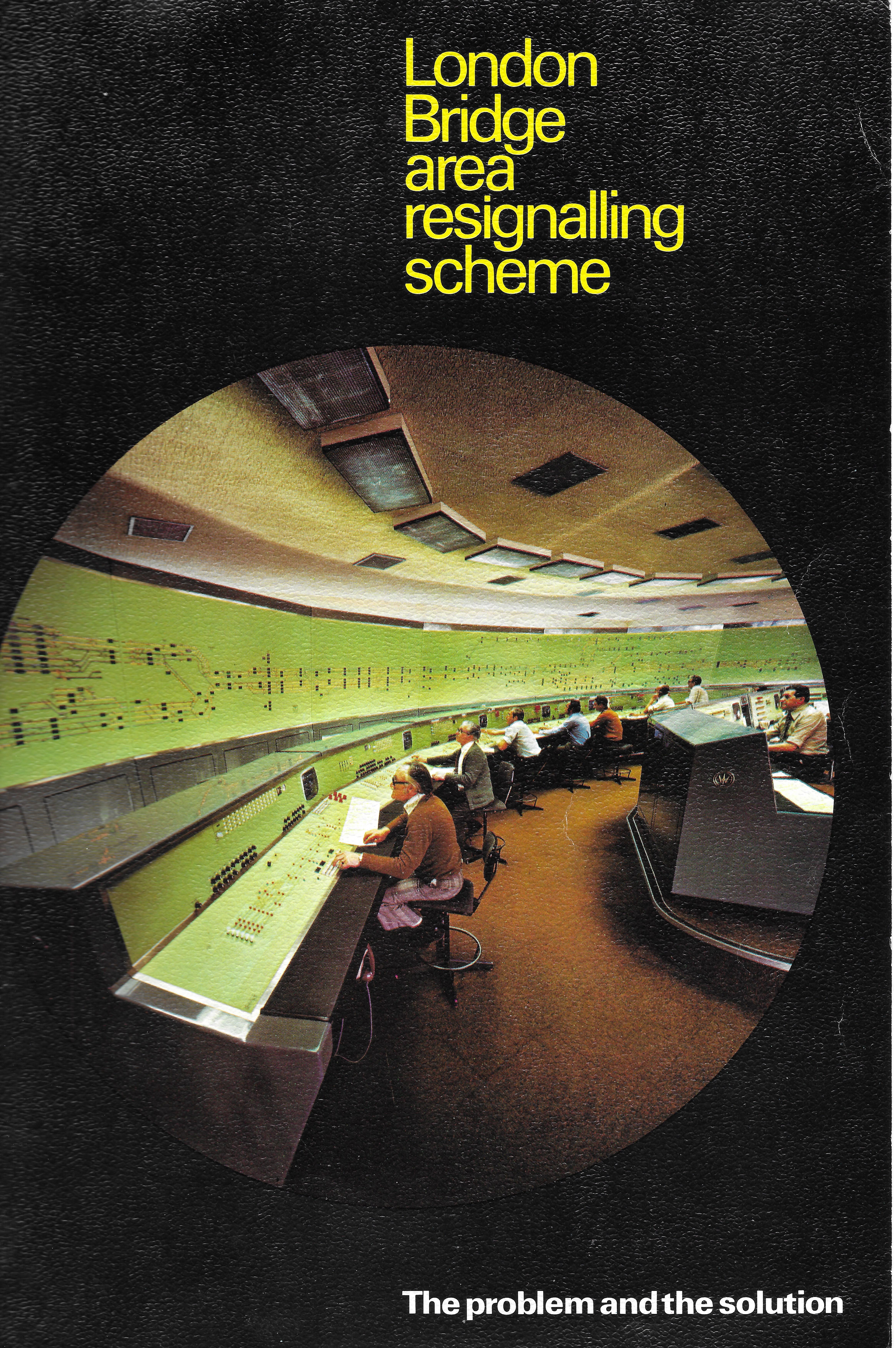
The entire area would be controlled via a massive new signal control room at London Bridge, which would mean the demise of at least 16 smaller signal boxes nearby.
Amazingly for such a large project, it was finished on time, at a cost of £21.5 million pounds in 1978. Below are some scans from a mini booklet produced by British Rail to commemorate the achievement.
I must thank Mr David Bonnett, who very kindly donated this leaflet and other materials to myself.
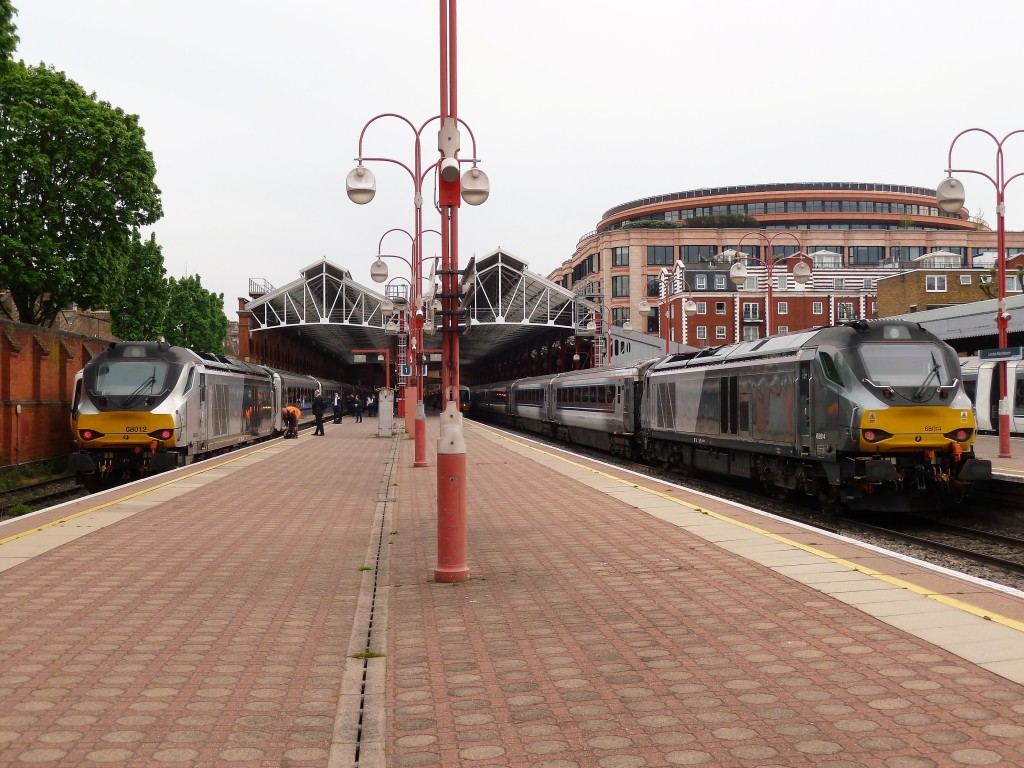
The last terminus to be built in London, Marylebone has never really been finished. It was designed with future expansion in mind, but still only has 6 platforms today, and for much of its life only had 4. Very quiet during the day it springs into live during the rush hours, or when a major event is going on at the nearby Wembley complex. However this is its charm. With an expansive concourse, it’s just a nice place to sit and reflect during those quiet times.
A Brief History
The station was built for the Grand Central Railway, a company formed out of the Manchester, Sheffield and Lincolnshire Railway. The terminus for that railway was only 2 miles north of Marylebone, but building an extension down to Marylebone would come with massive planning problems.
One of these was from the MCC at the Lords Cricket Ground, who massively objected to the original proposals which would see the railway go straight through the nursery end of the ground. After many years of argument, it was agreed that the railway company would purchase and relocate the orphanage next to the ground. This would enable the railway to be put in place using the ‘cut and cover’ technique. The ground was then put back as it was, with the railway running under the Nursey end.
The work on this completed in 1898, and it was then that the Grand Central Railway title was introduced. The new terminus however suffered from the money spent to do all the extra work, including a high speed railway link for the railway to Nottingham. It was therefore proposed to be a simple but elegant terminus.
A four platform trainshed was put in place, which only covered 495ft of the total 950ft platform length. It was envisioned that more platforms would be added during the early 20th century, but low passenger numbers would mean that this didn’t happen at this time. However the station would boast an extensive concourse, and the glass roof provided natural light which flooded in.
A station hotel was built opposite the station on Melcombe place, and is arguably the most opulent of all the London station hotels. A massive central atrium is inside and it still has that feel of early 20th Century rail travel. It was only converted once, into railway offices between 1945 and 1986. It was then purchased in 1986 and re-opened as a hotel in 1993.
Marylebone was never going to be a busy station however. The nearby Euston and Kings cross had been taking passengers north for over 40 years. Many attempts to close the station occurred between 1960 and 1986 (the Beeching review and cuts of 1966 meant that Marylebone would only provide trains as far north as Birmingham), but eventually was given a full reprieve as British Rail decided to creative a new working group for the station.
This allowed it to be more adventurous with its route planning, including heritage excursions and special event trains. The privatisation of the UK rail network in 1996 saw Chiltern Railways take over, and they have successfully managed it ever since.
A quick view of the current station
Moving toward the main entrance at Melcombe Place, you will see the ornate canopy over the road and taxi rank. Behind you is the impressive Landmark London Hotel. The pillars here are great, black with a red motif around a third of the way up.
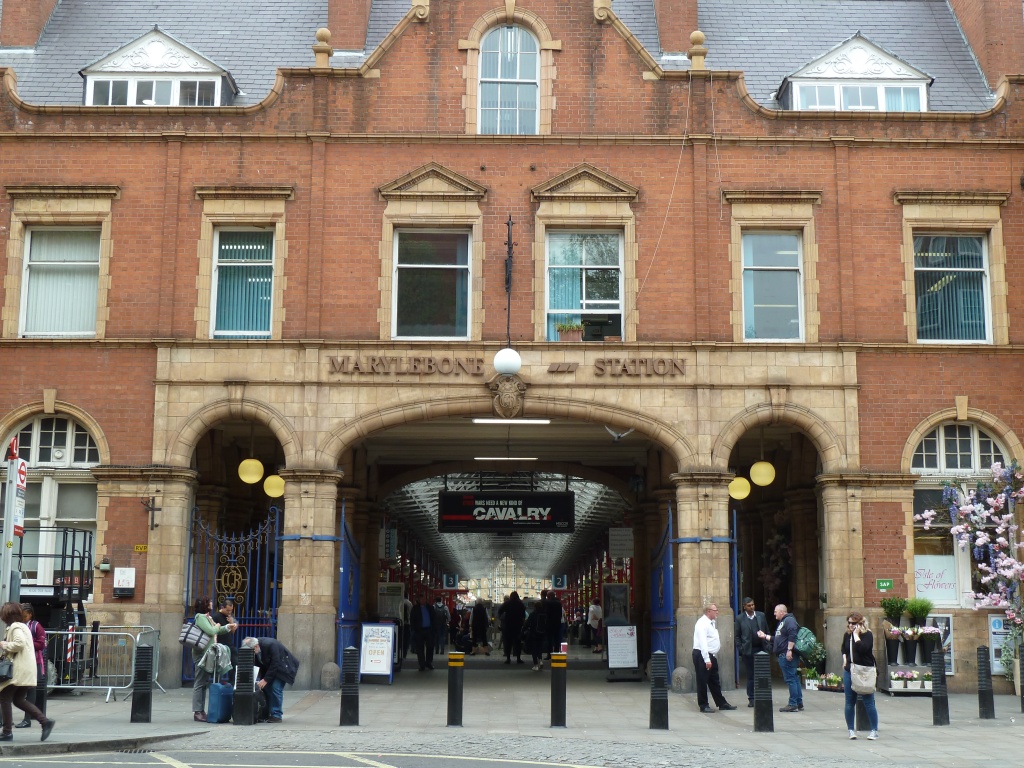
As we enter via the main entrance on Melcombe Place you will see above the writing of Marylebone Station in stonework. Next to this you can still see the uncoloured logo of Network South East (the last British Rail operator for the line before privatisation).
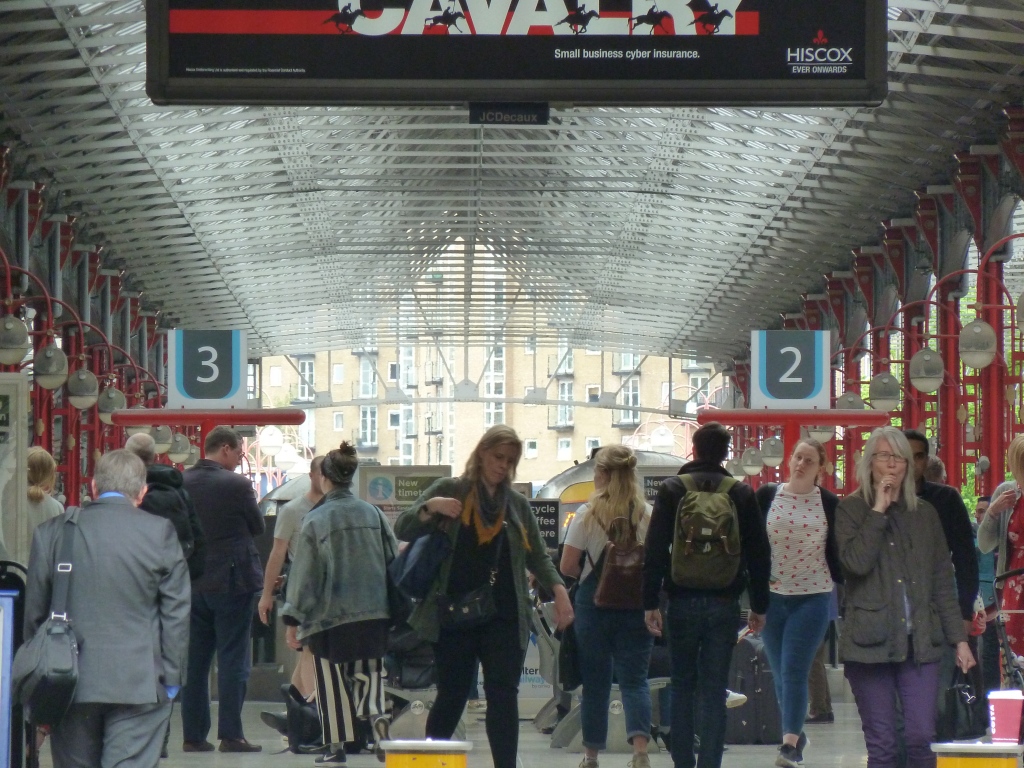
Entering the station, note the GCR logos on the gates. In fact this logo can be found all around the station, especially over exits in the brickwork. The station here opens out in front of you, with the platforms directly ahead under the impressive canopy and trainshed.
Move slightly further in and you will se an electronic information board to your left. Underneath this are electronic ticketing machines. Turn left now, and go towards and past these information boards so that they are on your right as you go past. You will see the station information booth in front of you. This is also the station reception as well.
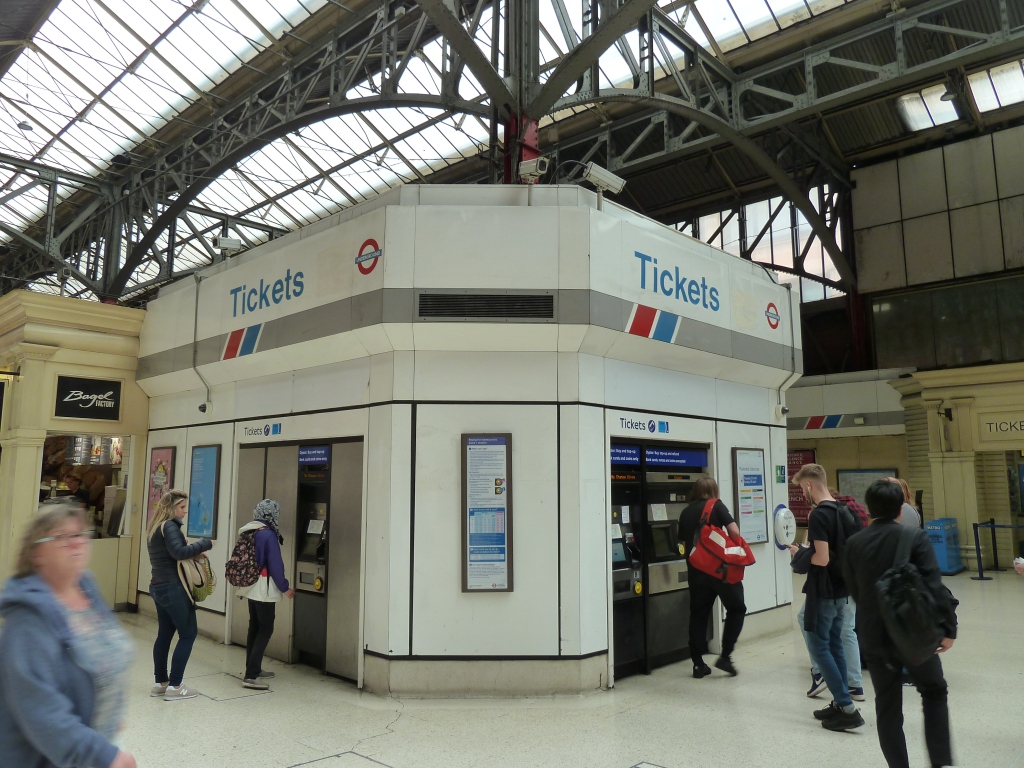
Moving past the information centre you will see yet more electronic ticket machines below some distinctive Network South East branding. If you now turn directly to your right you will see the ticket office. Moving forward a little further and the entrance to the Underground station is on your left.
Ticket machines with the old Network Southeast branding still visible
Turn 180 degrees back towards the information centre and go past it. The ladies toilets are directly in front of you. Now turn right and walk down this part of the concourse. Various retail outlets are on your left, the current M&S store is housed in what used to be the ticketing hall. Some Cash machines are on your right.
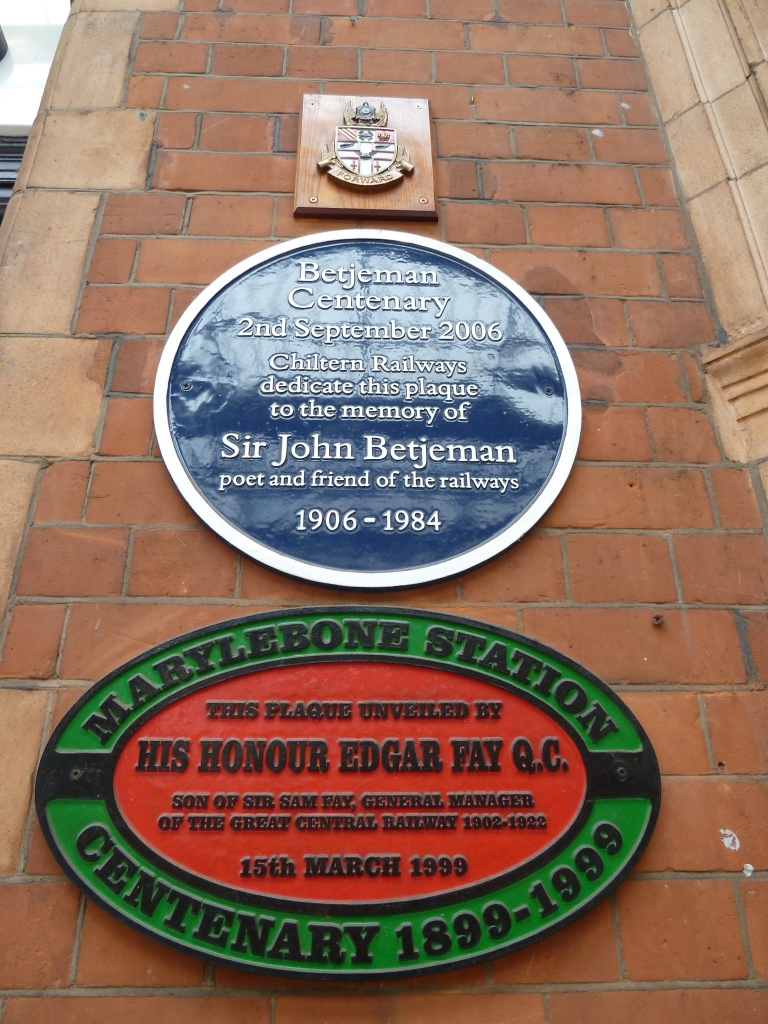
Around half way down this hall on the left are three plaques. The top one is the coat of arms of the Great Central Railway, the next is dedicated to the centenary of the birth of Sir John Betjeman, and the last one is dedicated to the centenary of the station in 1999.
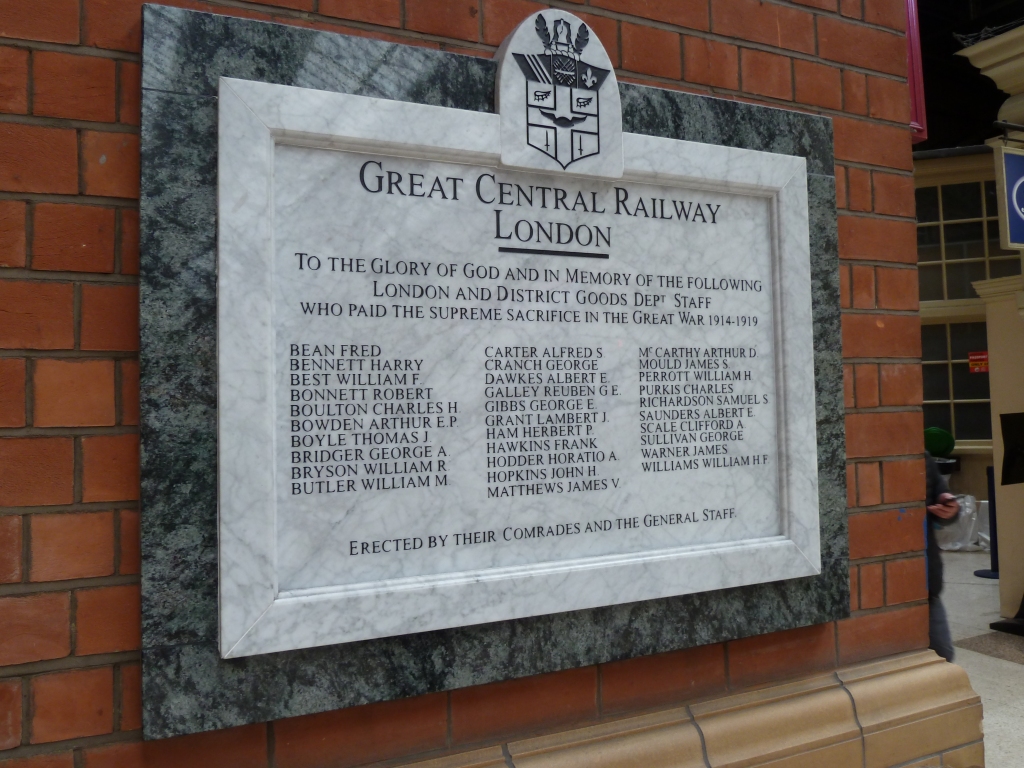
Moving back down the concourse to the end wall, where a further three plaques sit. These are dedicated to those railway employees who died during World War One. Two are on bronze sheets and the third is on a marble stone.
The marble plaque dedication to railway workers who were killed in the First World War
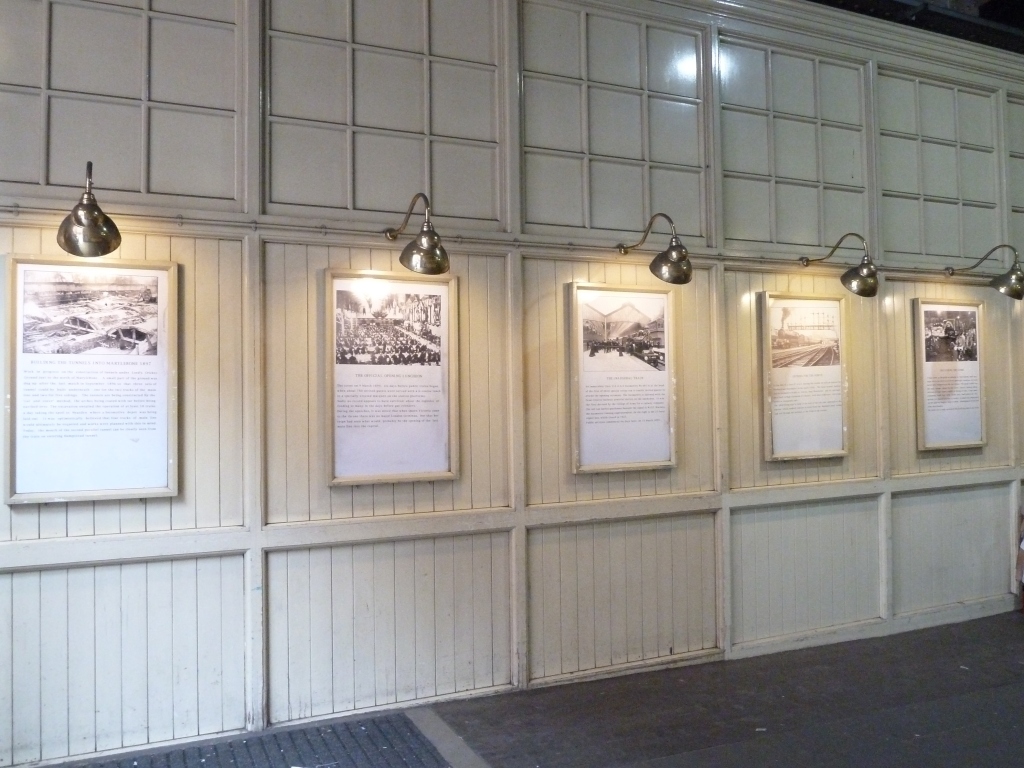
Carry on down past the plaques, and as it narrows, the Gents toilets are on your right. Now carry on through the arch and past a public house. You will see an exit here, but of more interest is the framed information on the walls, detailing the history of the station. They are very interesting and worth spending time reading.
Information boards at the entrance to the station at Harewood Avenue
Instead of exiting into Harewood avenue, lets re-trace our steps back into the station and go towards the Information centre once more. Take time to look up an appreciate the roof here, with the light flooding in over the whole concourse.
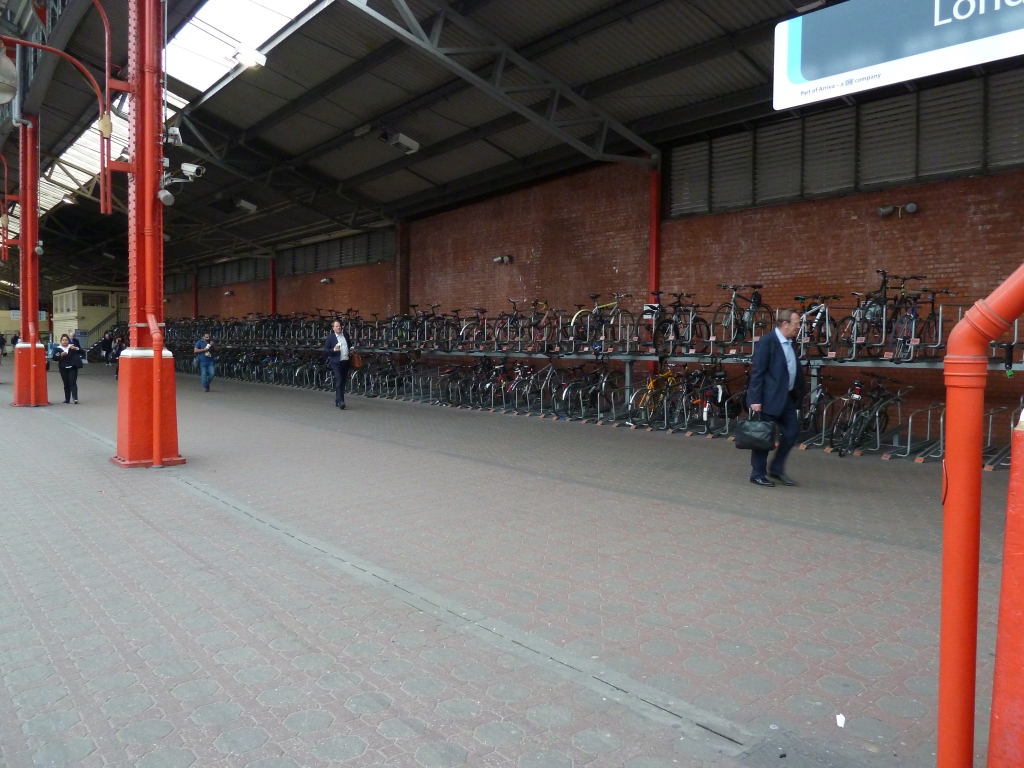
Go past the information boards and turn left to see the platforms ahead of you. If you are able, go through the gate lines onto these platforms. You really get the sense of the wider than usual platforms, and there is an extensive bike rack on platform 3 which is nearly two thirds the length of the trainshed.
The huge bike rack at platform 3
Move out further past the edge of the roof and look back. This shows off the trainshed really well, with the ornate pillars of red which hold it up. The station really does have a great feel, and although not as grand as say St Pancras, is nonetheless extremely appealing.
A view back to the trainshed
A view of trains departing and arriving at Marylebone can be seen below
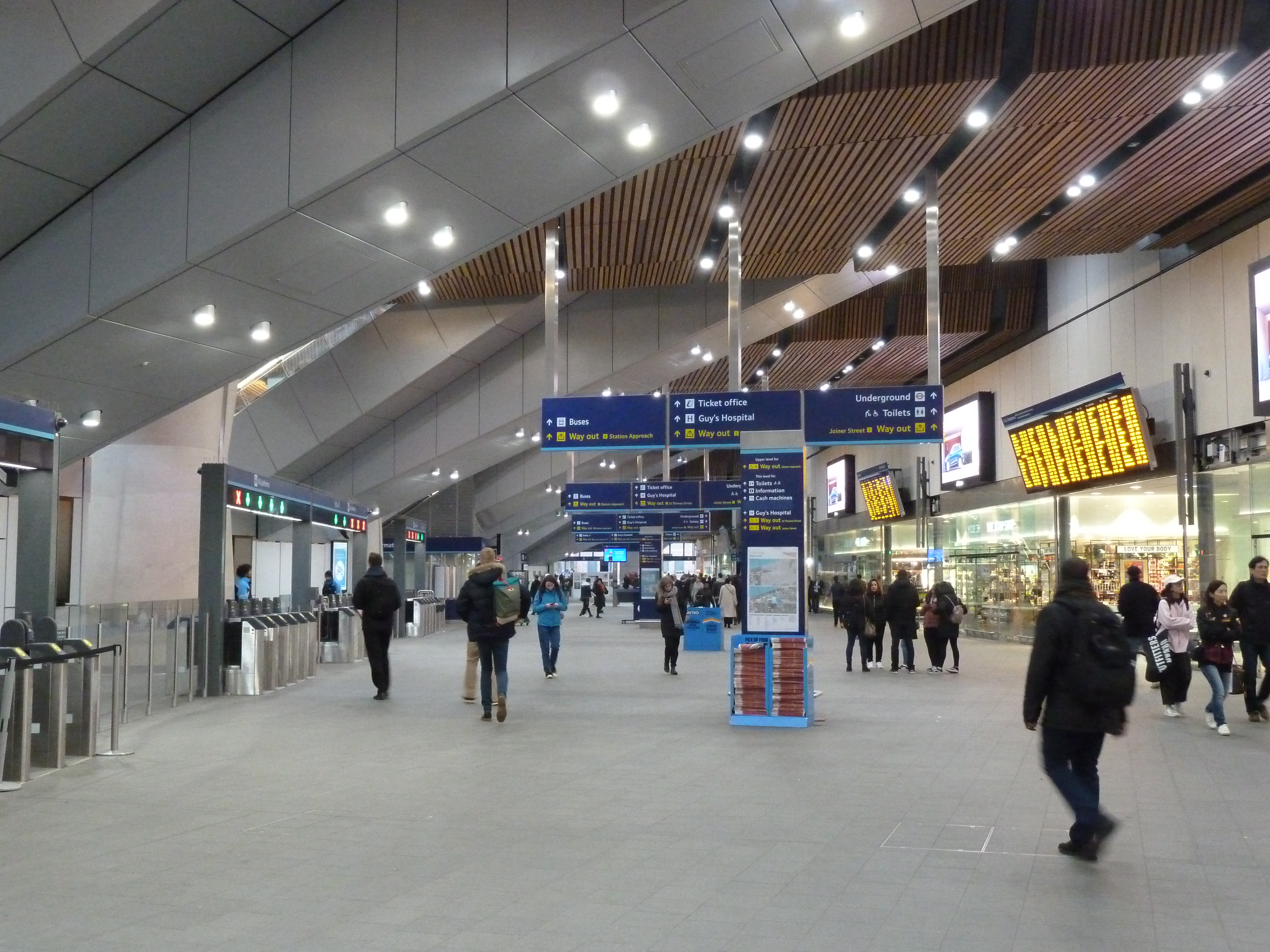
London Bridge is the oldest of the Termini in London, and one of the combined termini where terminating platforms are alongside through services. Often derided in the past as gloomy and difficult to navigate, a 21st Century makeover was completed in 2018. It is now a sleek modern building, its angled lines smoothed out with a curvy façade on one side. London’s tallest building, The Shard, towers above it, literally pinpointing the stations position.
A brief history
In 1831 a railway was proposed between Greenwich and Tooley Street. Because it would run through very congested streets, it was agreed that the best course of action was to build a viaduct. This would become a huge 878 arch bridge, made from 60 million bricks which were made in Sittingbourne, Kent. Initially the viaduct had a walkway which people could use for the sum of 1 pence, enabling elevated views of the city. However this was closed during the expansion of 1840.
Partly opened in 1836 as far as Spar Road, the full line to London Bridge was opened in December 1836. The station at this time was very basic, steps or ramps up to the platforms which were totally open to the elements having no sheltering roof or trainshed whatsoever.
Expansion came very quickly, with the London and Croydon Railway Company and The South Eastern Railway company taking routes North and South respectively between 1839 and 1842. The increased traffic gave the station a new building in 1844, the first of many rebuilds London Bridge would have.
The most significant of these was in 1850, where the station was divided in two, the South Eastern taking control of the North side, and the newly formed London, Brighton and South Coast railway company the South side. A huge wall was erected, with both sides having differing rules and regulations, causing services such as horse drawn taxis to pay differing charges as they traversed the station.
This remined in place until 1923, when all the southern rail companies were amalgamated into the Southern Railway Company. A footbridge was built to link the two stations in 1928.
The arches under the station were used in the Second World War as air raid shelters, although conditions were very grim. Inspections declared they were unfit for use and demanded improvements to make them both safer and hygienic. Unfortunately, before any real improvements were made, a bomb hit London Bridge in February 1941, killing 68 and injuring a further 175.
A Major rebuild of the infrastructure and station occurred in the 1970’s. This included new signalling and rerouting of the lines in and out of London Bridge. The building was given a modern design, but people would still complain that it was cramped and uninviting.
It wasn’t until the early 2000’s that another rebuild would take place. The most radical and expensive so far, this time they seem to have got it right , as I shall explain in the rest of the blog.
A quick view of the current station
Although I label this as a quick view, the station is so vast that being quick here is not something i’d recommend if you wish to appreciate this new station.
Entering from the underground station, after going up the escalators you enter a passageway which is Joiner Street. Move into Joiner Street and you should soon see on your left the entrance to the Western Arches.
The Western Arches
Moving into here, the old pillars that are holding up the railway above you, go down this corridor in a pleasant symmetrical fashion. Shops are placed at the side, and the feel of this section is fantastic.
At the end of the passageway is another intersection, this time with Stanier street. Of note here is the plaques along the wall detailing the history of the station layout, well worth a look if you have the time.
Plaque in Stanier Street
Moving back to the end of the Western arches, and head of you is the main concourse – a sleeper in on one of the walls just as you are about to enter the concourse is dedicated to the opening in 2018.
Dedication plaque
Turning right here will take you down past more shops on your right, and the main ticket office on your left. Carry on down to the exit and you will see on your left a memorial to the railway workers who died in the first world war. This exit would take you into St Thomas’ street, next to St Thomas’ hospital, should you go through it.
First World War Memorial
Turning back into the main concourse, head all the way back to the Western Arches and carry on. You will see various gateline entrances to your right, as well as a big escalator and stairs in the middle which will take you up to the upper concourse and the bus station. Lets go up and take a quick look.
Up the escalator ahead of you is the glass frontage of what used to be known as the main entrance to the station. If you were to exit there, the Shard would be immediately to your right, with the bus station immediately in from of you. It is worth going out here just to marvel not only at the Shard, but the impressive all glass frontage to the station here (see the opening picture of this blog post).
Moving around the upper concourse the sense of natural light and space is very evident. Moving to the left you will find gatelines for Platforms 10-15. If you gain access to these platforms, try to take a moment to stand at the end of the terminating platforms, and you will be greeted by a very pleasant sight as the canopy structure over the platforms snakes away from you, yet another good photo opportunity.
A view down platforms 14 and 15
Lets go back downstairs to the main concourse, and turn right towards the exit for Tooley Street. Various gatelines will be on your right, as well as an information centre. Exiting into Tooly Street will give you a look at the new sweeping façade at this entrance. This mixes well with the original arches, which can be seen meandering away towards Greenwich. The view as you enter the station again is below.
View after entering via Tooley Street, note the huge escalators towering above you.
Moving into the station, we go through a gateline into the inner concourse. Impressive concrete pillars, looking like huge egg timers, are dotted around, with seating around their circumfrence. The space here is very welcoming due to the high ceiling. Various lifts are in the centre too, and ahead of you are the huge escalators which take you to platforms 1-15.
A view across the concourse post gateline, with the lift shafts, pillars and high roof.
Departure boards are placed around the lifts and on the side walls, really the wealth of information about arriving and departing train services is comprehensive.
I visited during rush hour, and yes it was busy, but the station layout as it is now didn’t seem to have any major congestion points. The station and surrounding structure is still being worked on, but all the major components are open, and it seems that at last London Bridge is able to cope with the passenger numbers it receives.
The video below shows London Bridge platforms at evening rush hour.
The essence of a true commuter station, very quiet during the day but in the morning and evening a hive of activity. Served only by the SouthEastern Railway and serving only Kent and Sussex, this central London hub has a varied but solid history.
A Brief History
The South Eastern Railway Company started construction in 1863, from a design by Sir John Hawkshaw. The railway entered via a 706ft bridge which at this stage only carried 5 lines. This was increased to 10 during the late 1800’s. The engine shed roof was an impressive 190ft wide and more than 680ft long, with a central lantern section which ran almost the entire length.
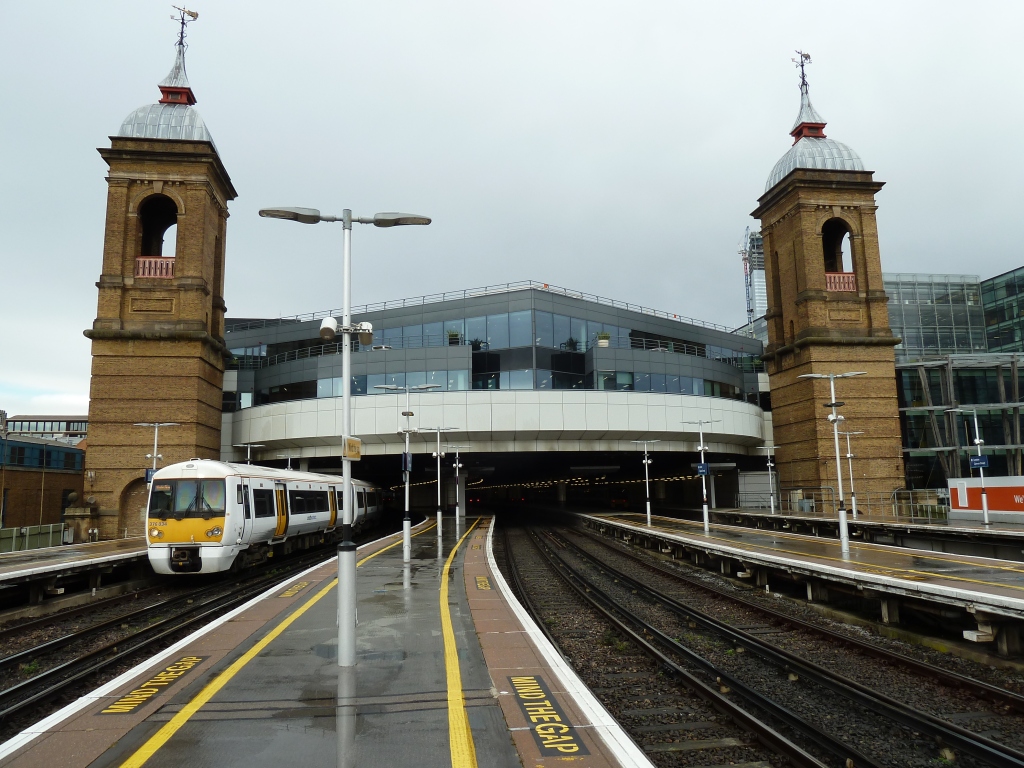
On the bridge side, two towers sit either side of the bridge, each adorned with a square domed roof and spire. It was found during restoration in 1986, that the east tower contained a water tank, either for replenishing the locomotives or for use in powering the stations hydraulic lift systems.
A hotel was built on the front entrance of the station. At only 5 stories it was one of the smallest station hotels, but had turrets mirroring those of the main towers. Like most railway hotels however, the popularity waned in the early 1900’s and it closed to customers in 1931.
The station officially opened in September 1866, and provided additional services to and from Charing Cross via a 7 minute shuttle, considerably quicker than the 35 minute walk. However, the advent of the district railway a few years later would render these shuttles almost useless.
The trainshed roof was extensively damaged during an air raid in 1941, and engineers deemed that replacing the glass would not be possible. The structure stood in skeleton form until 1958, when it was demolished in the first re-model of the station.
The new office complex which replaced the hotel was derided by critics, and certainly wasn’t as grand as the original Hotel. It was followed in the 1980’s by a ‘floating’ office block above the station platforms, held up by a 6000 ton metal frame. The block nearest the river has a roof garden, and slightly protrudes the two towers.
A quick view of the station today
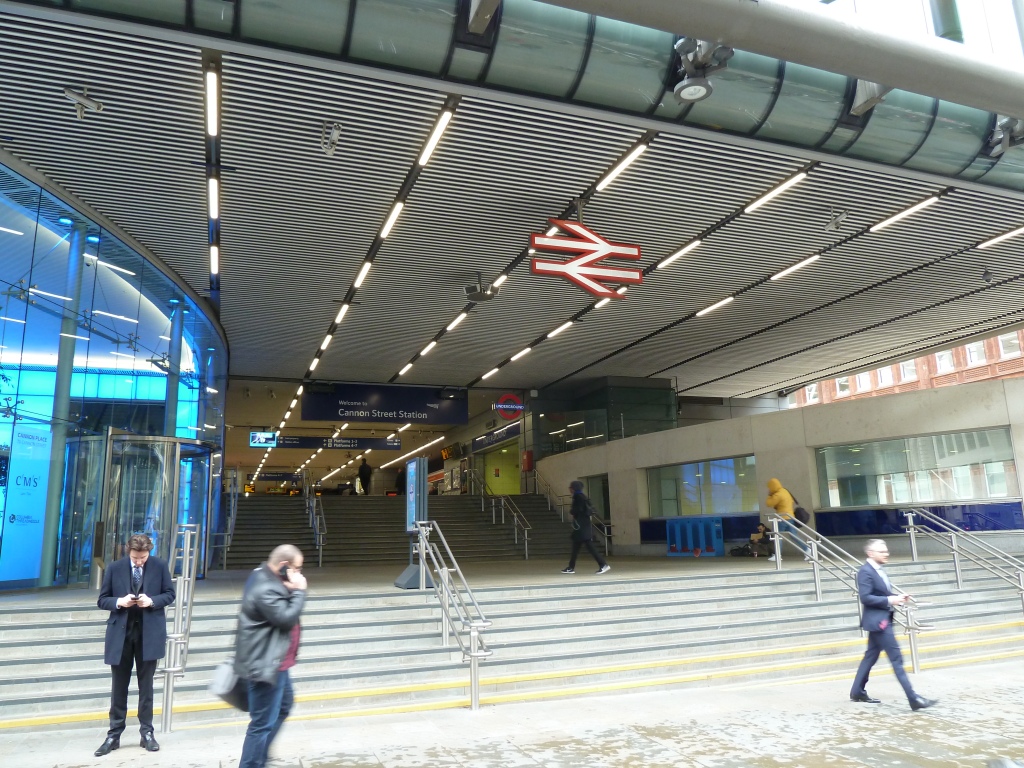
Going in via the right hand steps on Cannon Street itself, you are greeted by a British Rail Sign hanging from the roof and a blue “Welcome to Cannon Street Station” sign. Immediately at the top of the two flights of stairs to your right is the entrance to the Underground station.
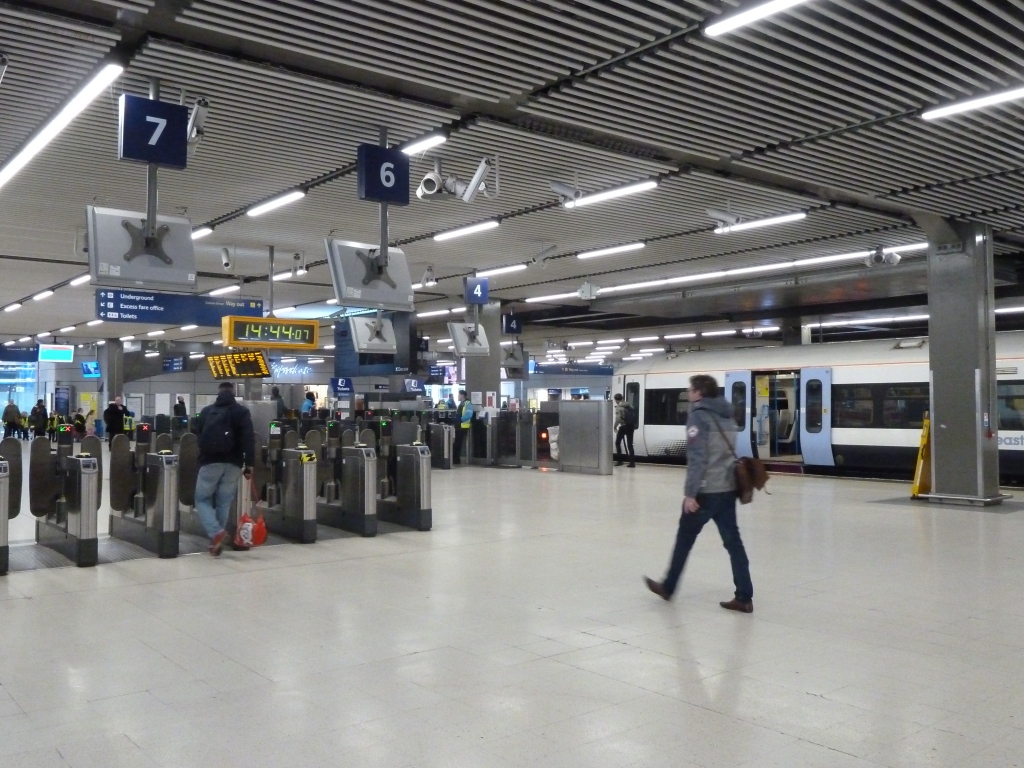
The low ceiling, clad in silver stripes with bright lighting makes you feel penned in. The floor, a cream tile with grey borders almost makes it feel like a department store. This aside, you remember that this is just a “people mover” station, so modern clean almost clinical lines wont be noticed by the thousands using it each day.
View to the station entrance from platform 7
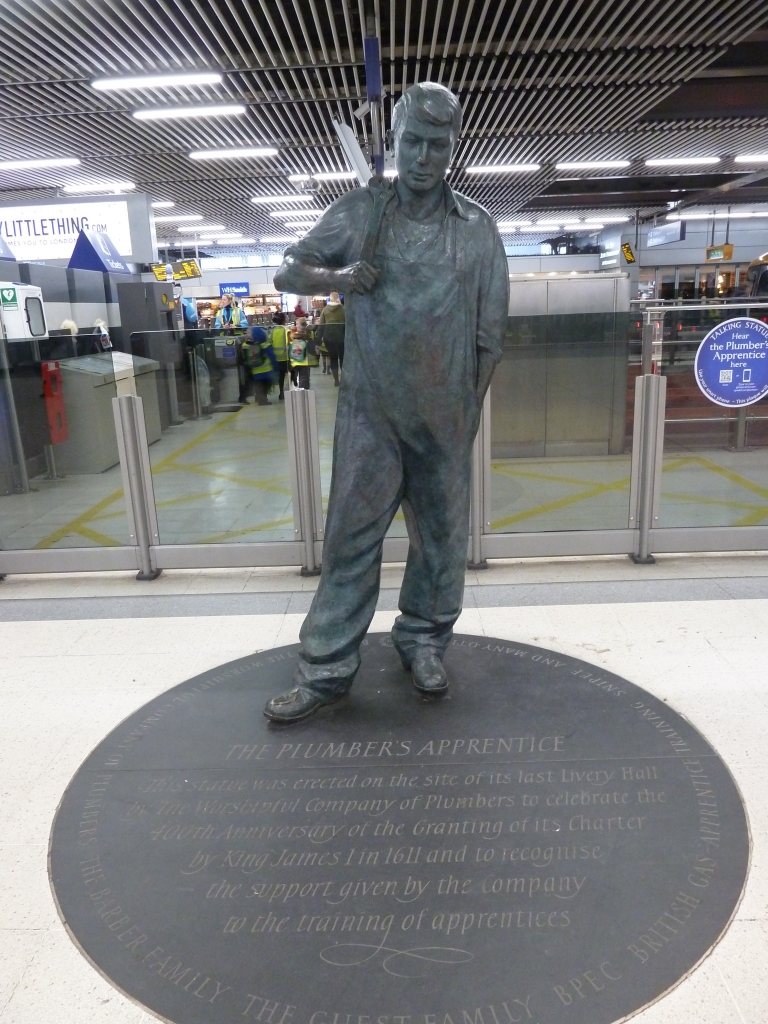
To the right is a coffee shop, then the ticketing office and finally the toilets. Straight ahead are the gatelines to platforms 4-7. Look to your left here and a statue called “The Plumbers Apprentice”, which commemorates 400 years of the Worshipful Company of Plumbers. Their hall was once on the ground of the station.
The Plumbers Apprentice
Carry on past the statue and on your right will be ticketing machines and the gatelines to platforms 1-3. Directly ahead is a retail outlet and a pub/restaurant. Turning back towards the street and by the steps on your right is the lift down to the Underground Station.
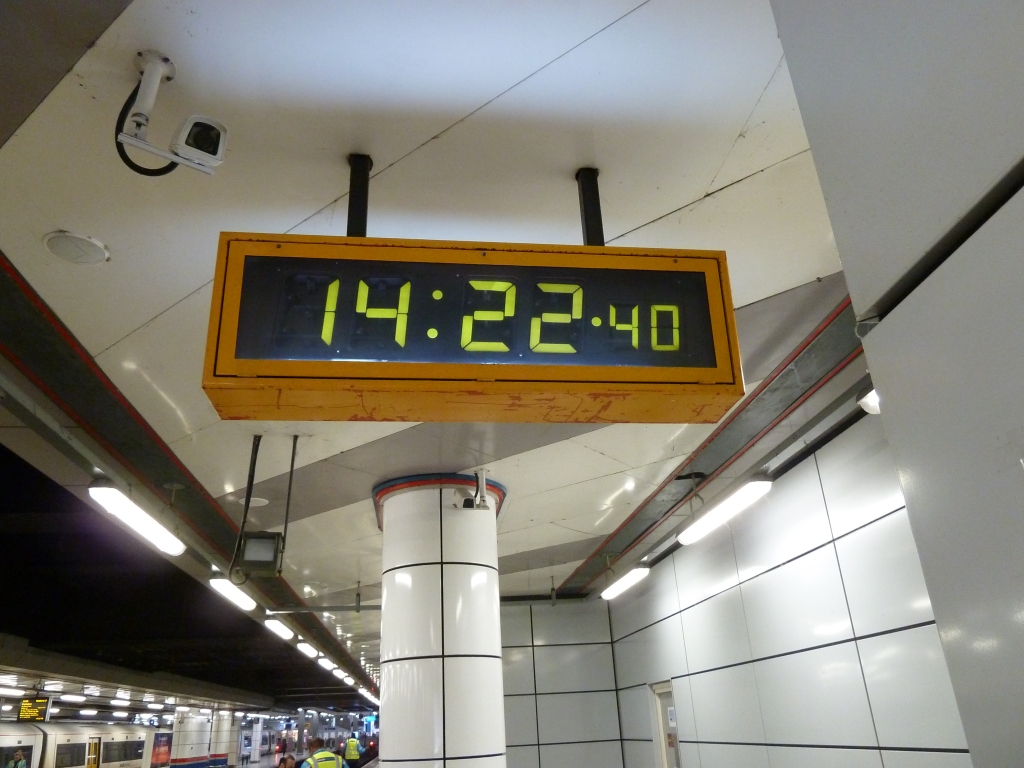
Moving onto the platforms, ex Network South East overhead clocks continue to click away, and the pillars in the centre of the platform still contain the Network South East colour banding at the base.
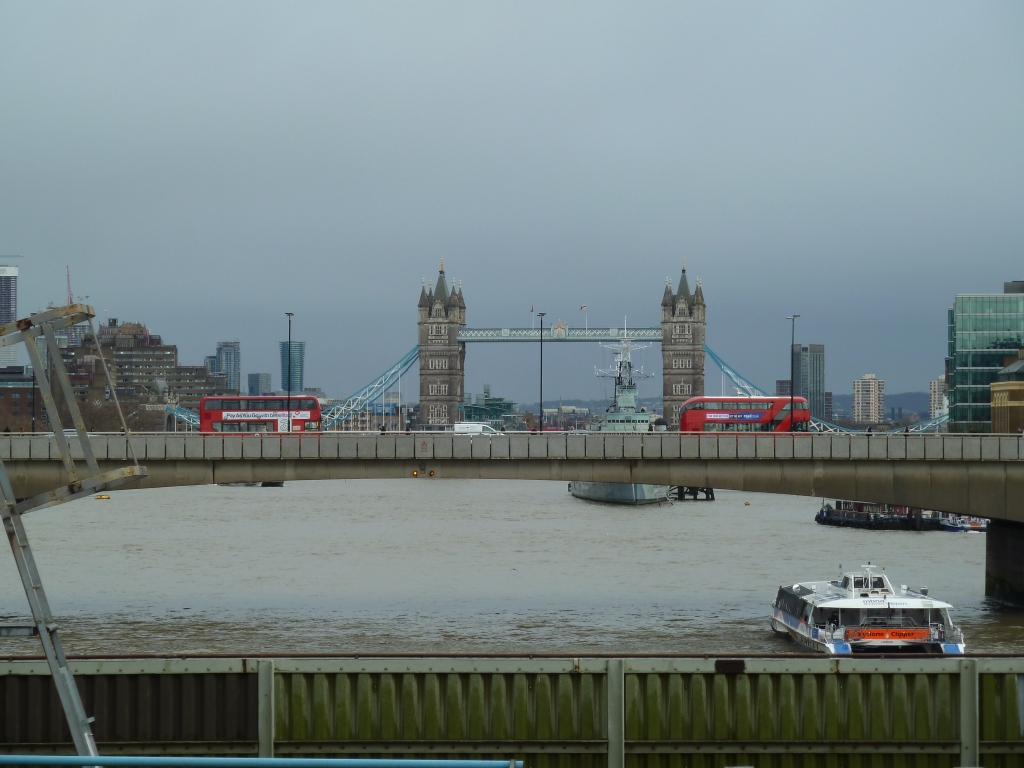
As you move outside, to the left is a view over the River Thames to Tower Bridge, HMS Belfast and The Shard. To the Right you will see both Southwark and Blackfriars bridges, as well as the Tate Modern.
But look back towards the station and the full glory of the two original towers rise before you. A very impressive site, and totally at odds with the office block in the middle, yet somehow it does fit together. In my view it only goes to enhance the old structure.
The two towers of Cannon Street
Cannon Street with all its stark modern looks deceives you, and the small things like the Statue, Network South East reminders and of course the towers are reasons to just spend a little more time looking around you, rather than rushing to get that train home.
A gateway to Europe, the finest of stations, but nearly demolished in the 1960’s. An amazing station, with plenty of history, a huge trainshed and a 5 star Hotel attached. The story of St Pancras is long and full of near disaster moments, but now it stands proud as the main Termini of Eurostar, and with it the first station many overseas travellers will see.
A Brief History
The Midland Railway was desperate to get away from sharing Kings Cross with the Great Northern Railway. So when a bill was passed in 1863 for a railway between London and Bedford, they jumped at the chance to construct a new station between Kings Cross and Euston. It would be known as St Pancras, after the local Parish.
William Barlow designed a radical trainshed for the station, 245ft wide, 689ft long and 100ft high, it was the biggest single span roof in the world for a time.
The void left by excavation works was used to store beer and other goods, and was known as ‘the vaults’. This is now a superb shopping arcade linking the station down its spine underneath the trainshed.
The hotel was built to rival the one next door at Kings Cross, and was a highly flamboyant affair, the architecture lending itself to Italian and Belgian influences. It is often seen as the face of St Pancras. However it never seemed to make a profit and was closed in 1935, only to later be used as crew sleeping quarters and offices for British Rail Catering Division.
A concerted effort by many historians and railway enthusiasts (including Sir John Betjeman) stopped the bulldozers destroying the station in the late 1960’s. This however didn’t stop the station from falling into dis-repair.
Amazingly though, a major lifeline was given when in 1994 the government approved St Pancras as the Terminus for the new Eurostar service. A major renovation project started in 2001, and by 2007 after restoration and modernisation (including a modern extension to the trainshed, if not in keeping with the original), St Pancras re opened fully.
A quick view of the current station
As you enter via Pancras Road, through a huge glass façade, the concourse opens out in front of you. To the left, escalators take you down to the underground station, while a lift to your right either takes you down also, but will take you up to the SouthEastern High Speed platforms.
Moving forward slightly, turning right past a coffee shop, ahead is a new pub restaurant and also 3 sets of escalators. Two sets take you up to the HighSpeed platforms, the middle set taking you down to the Underground.
Turning past the pub, moving forward past a retail outlet on your right and food to your left, another retail unit is in front of you. Turning right here will take you to lost property, toilets and the station office. Turning left and carrying down the corridor you will come back to the main concourse, where a departure and arrival board sits above other retail outlets.
Now turn right and go down towards another exit, this is the Midland Road entrance. To your right as you walk down is a ticketing centre, and at the end on your right, access to the Thameslink platforms, seen below.
Thameslink underground platforms, labelled platform A and B
Back up from Thameslink, go straight on into the old Vaults, which is now a great arcade full of mainly high end retailers, with a few pianos in the centre aisles for the public to use! This area also gives you the first real glimpse of the original trainshed, a glance upwards reveals its vast nature. A quarter of the way down on the left is the entrance to the Eurostar terminal.
A view down into the arcade from the Grand Terrace
Going up a set of stairs brings you to the Grand Terrace, and a statue of Sir John Betjeman. He is looking up, almost encouraging you to do so. The massive trainshed extends out from here and is a superb sight. Looking towards the back, the Hotel can be seen, as well as a clock and an art installation by Tracey Emin. This is part of a series of artworks commissioned by The Royal Academy.
Moving toward the Hotel, another statue is very prominent. This is called “The Meeting Place” and stands at 30ft high. Along its base are castings of various railway events.
Turn 180 degrees and the Eurostar platforms and trainshed are before you.
If you go to the other end of the trainshed on this level, you will come to the platforms for East Midland Trains. Going back downstairs, head back to the back of the arcade and through into the Underground station. Here you will find information, ticketing and entrance to the Circle, Hammersmith and City and Metropolitan lines.
Carry on down this corridor and on your right, you will see a dedication to the Kings Cross fire in 1987.
Following this corridor to the left will take you down to the entrances for the Victoria, Northern and Piccadilly lines. There is also a piano here, if you feel so inclined!
Carry on down the corridor and you will have come full circle if you take the escalators up to the main concourse.
A great station, made better by design, yet old charm can be found if you look for it. Speaking of which, as a little challenge to those who don’t know, try to find this gem in the Underground Stations network of entrances and exits!
King’s Cross; for a lot of people the station symbolises two very different train services. One steeped in history – The Flying Scotsman – the other pure fantasy – The Hogwarts Express. Whilst one is real and the other fictitious, it is fair to say that if you mention Kings Cross to many of the public, they will utter either or both of them.
A brief history
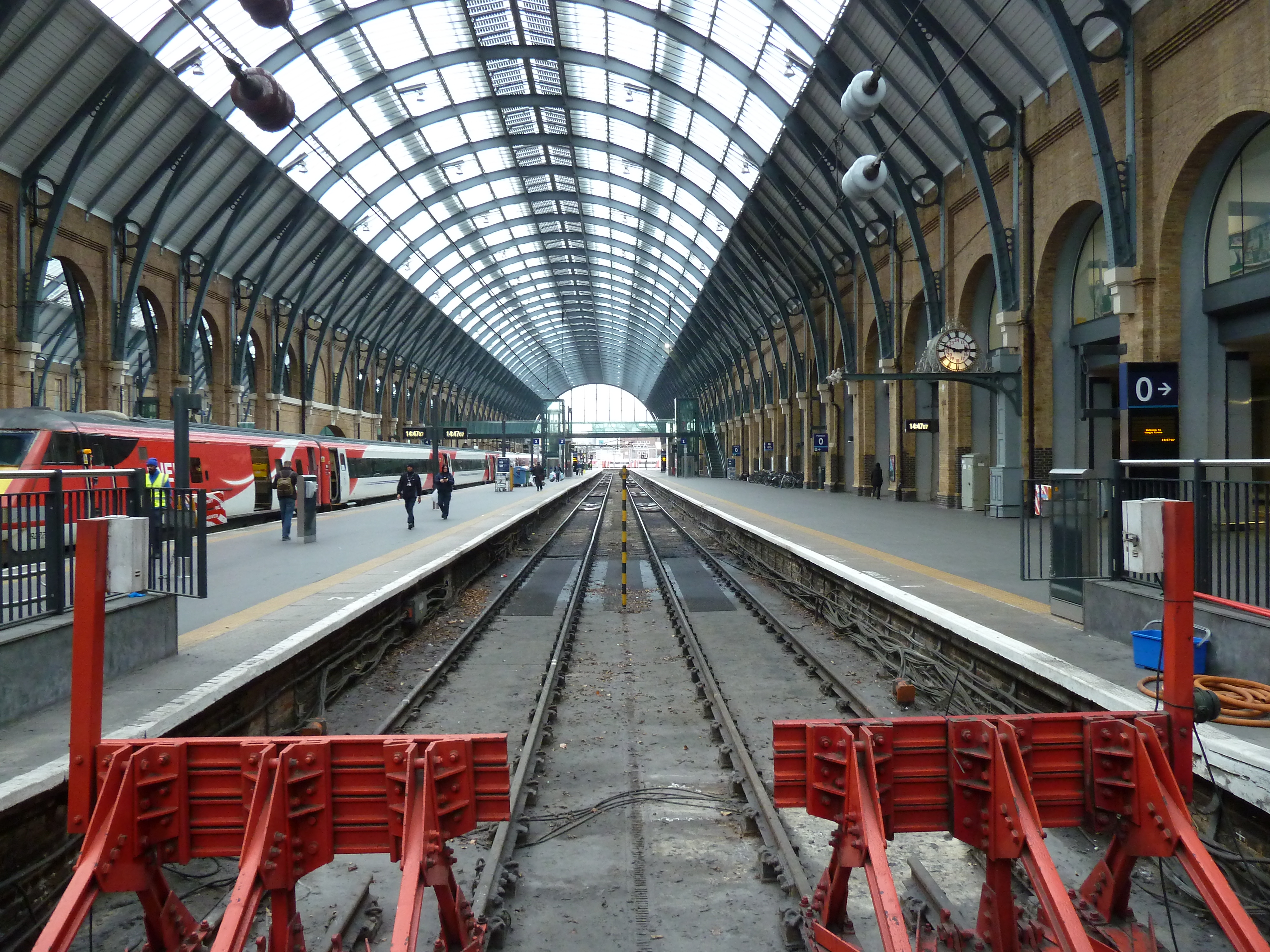
A practical station for a practical railway. That is how the Great Northern Railway saw it when they opened it in 1852. A station with a modest frontage, made from yellow London bricks and a wooden roof, complimented with two 100ft roof spans over the platforms. These roofs being supported by brick pillars, today in the centre of island platform 4 and 5.
Trains enter and leave the station via the Gas Works tunnel, which passes under the Regent’s Canal. A major goods yard for coal was also contained within the station, although this does not remain.
It looked totally at odds with St Pancras next door; that station when opened 16 years later was oozing with grandeur. A clock adorned the front of the building, and quirkily was rumoured to never have the same time showing as that of its neighbour at St Pancras. King’s Cross as a railway station, however, would for the majority of the next 150 years be the more successful of the two.
For all the footfall though, the station remained unloved for a long time. Indeed in the 1960’s, the square out front was partially covered with a new travel centre for British Rail. This however obscured the lower half of the original frontage, and looked at odds with it.
A quick view of the current station
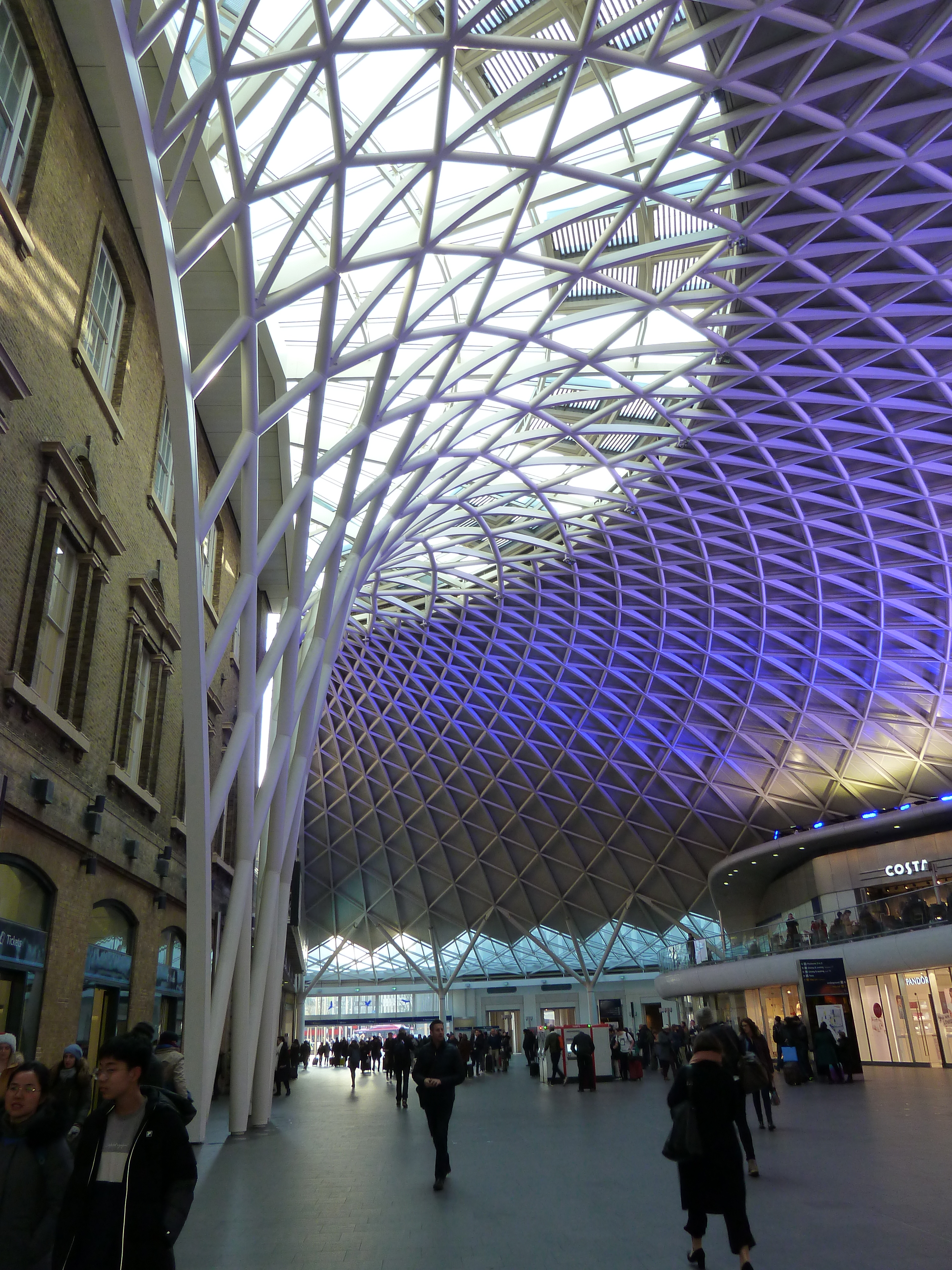
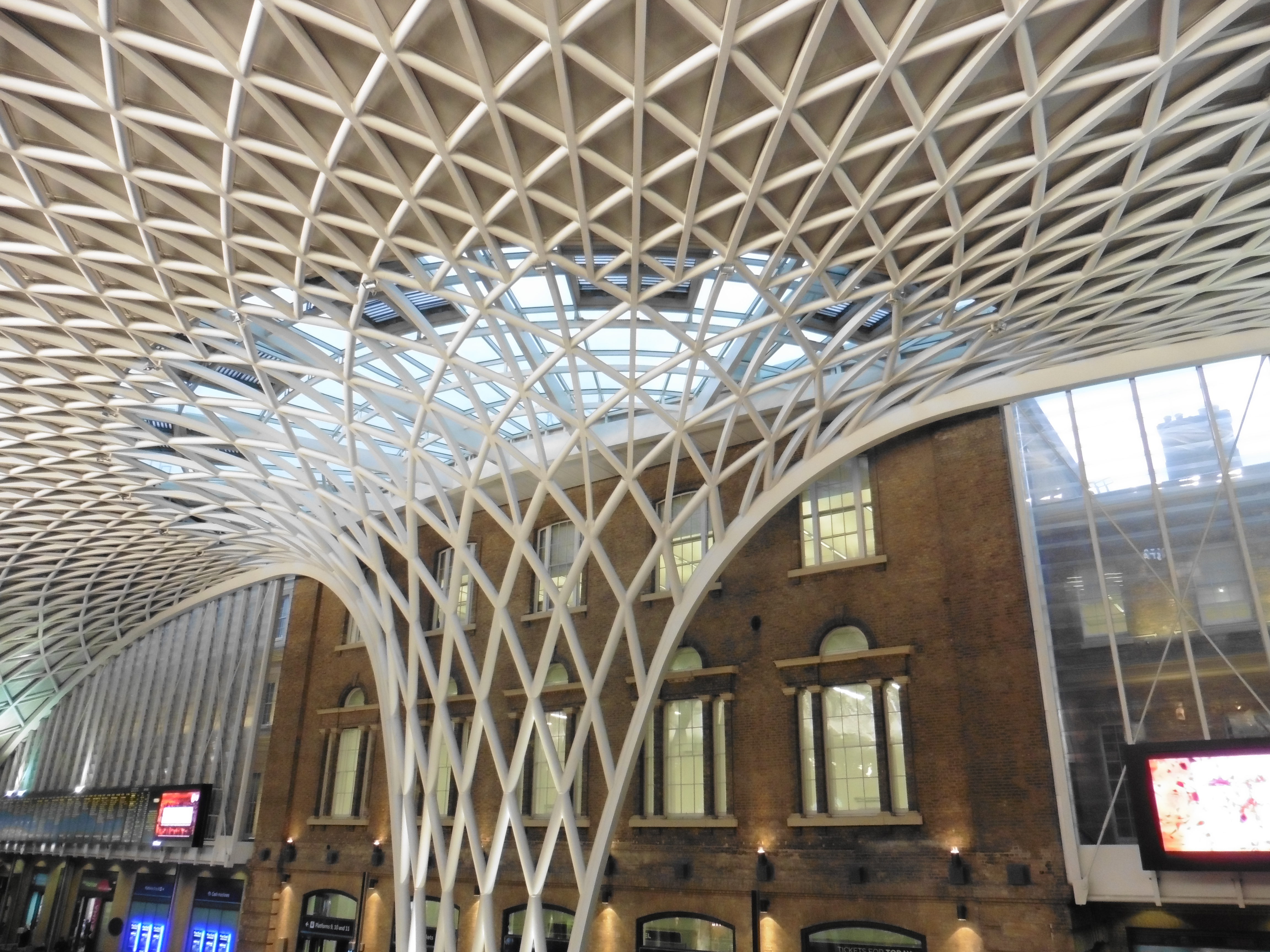
In 2007, work started on a new concourse, and what a unique structure it is. A single rising 150ft “Diagrid” roof, underpinned at its base down 50ft. It spreads out like a metal web, encapsulating the new concourse with its shops and bars. The feeling of space even during the busy periods is amazing, and differing colours are sometimes projected upon it.
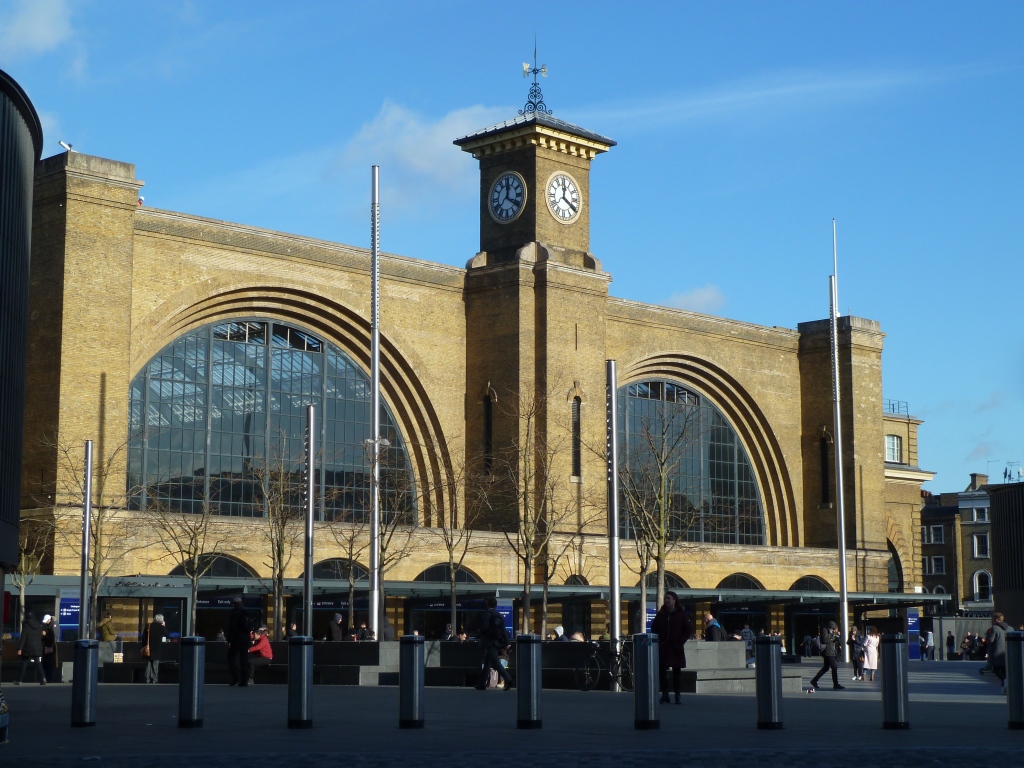
The travel centre was removed, enabling the square to be reinstated and the full frontage to again be seen. To the left side of said frontage, an entrance to the new concourse can be seen. Going through this, the superb new roof opens up in all its splendour. Immediately to your right are entrance gates to the platforms, to your left are escalators up to a mezzanine level This contains a seating area and eating and drinking places.
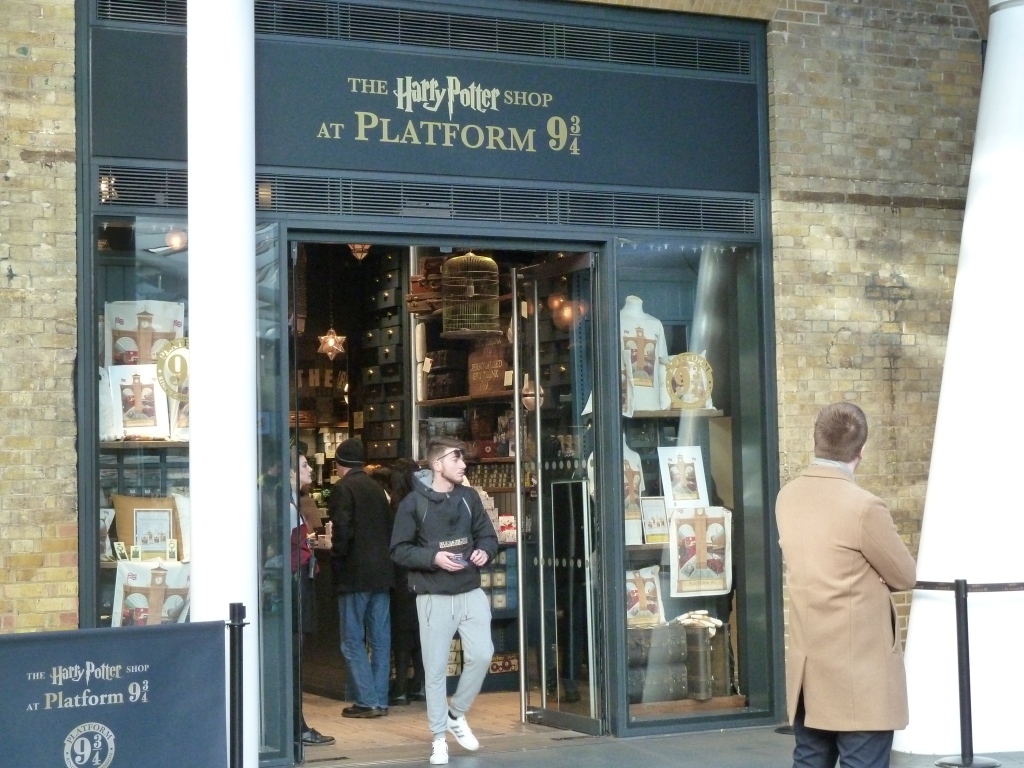
Going back down to floor level via the escalators on the other side of the mezzanine, if you turn right, you will see arrivals and departure boards, and underneath the new travel centre. To the left of the travel centre is the Harry Potter shop, with a photo opportunity platform 9 3/4 area.
Going under the mezzanine, more shops on both sides as you are then greeted with a glazed front, from which you can see St Pancras International. Stairs down to the Underground are also here, one of many access points to the labyrinth of tunnels which form King’s Cross St Pancras underground Station.
Pictures below were taken on 22nd January 2019, and thanks goes to the station manager and Network Rail for enabling me to photograph extensively on that date:
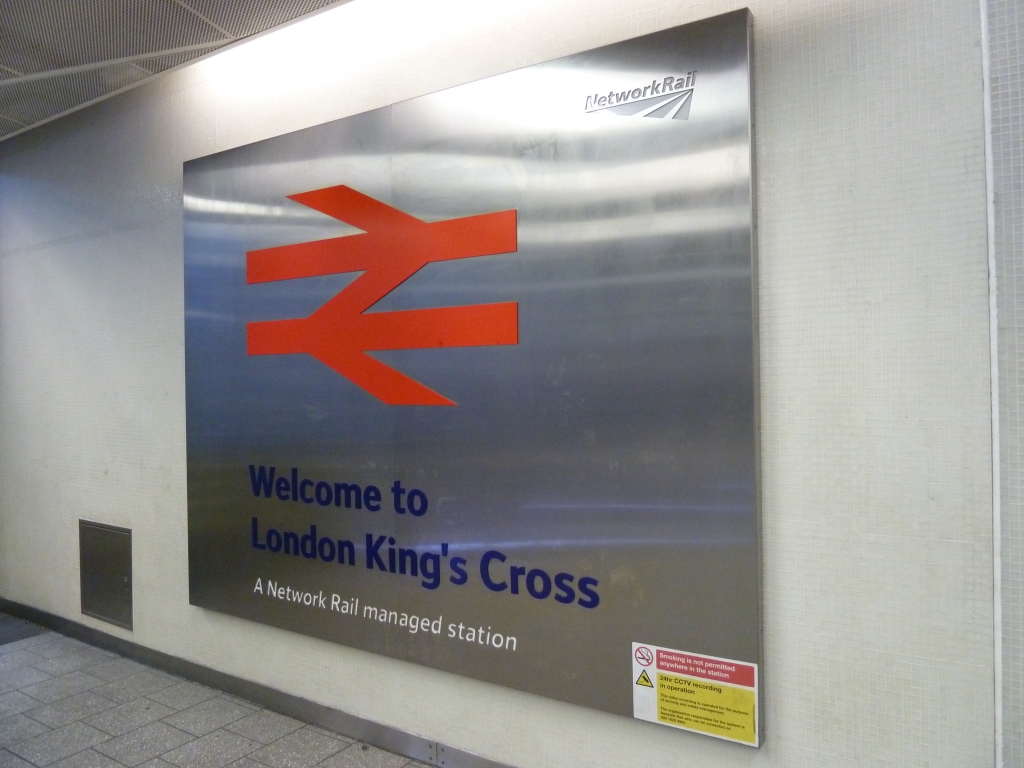
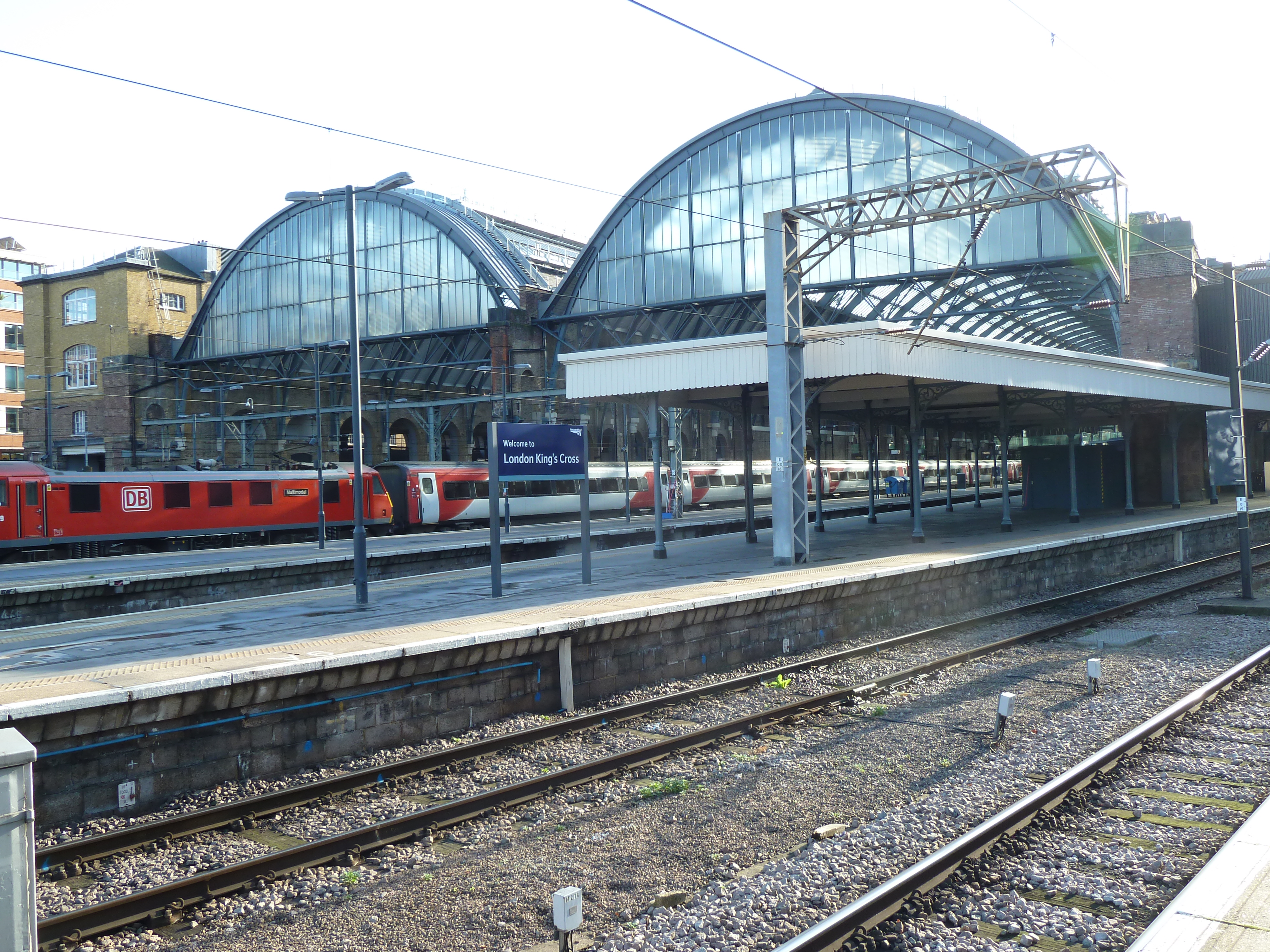
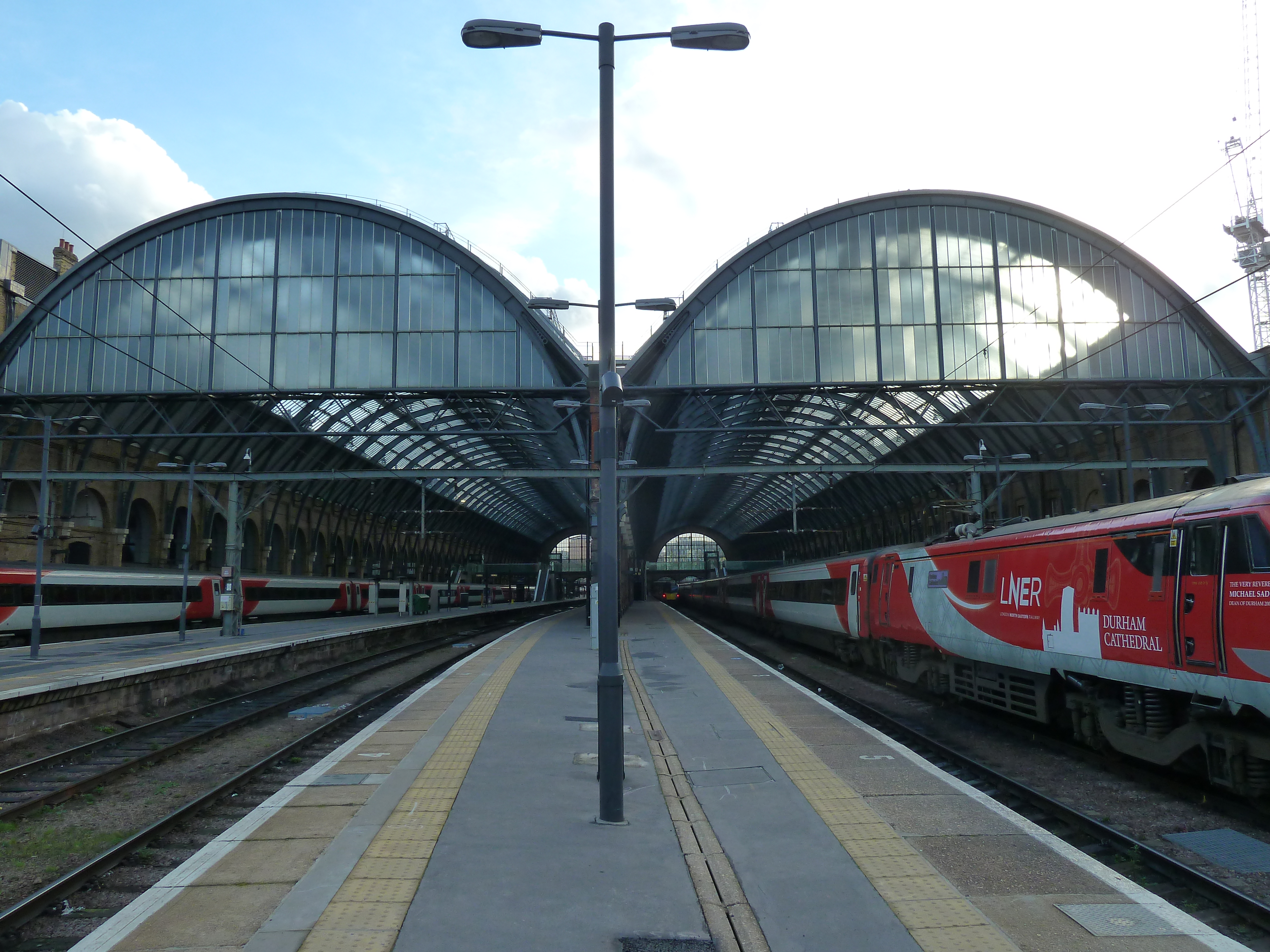
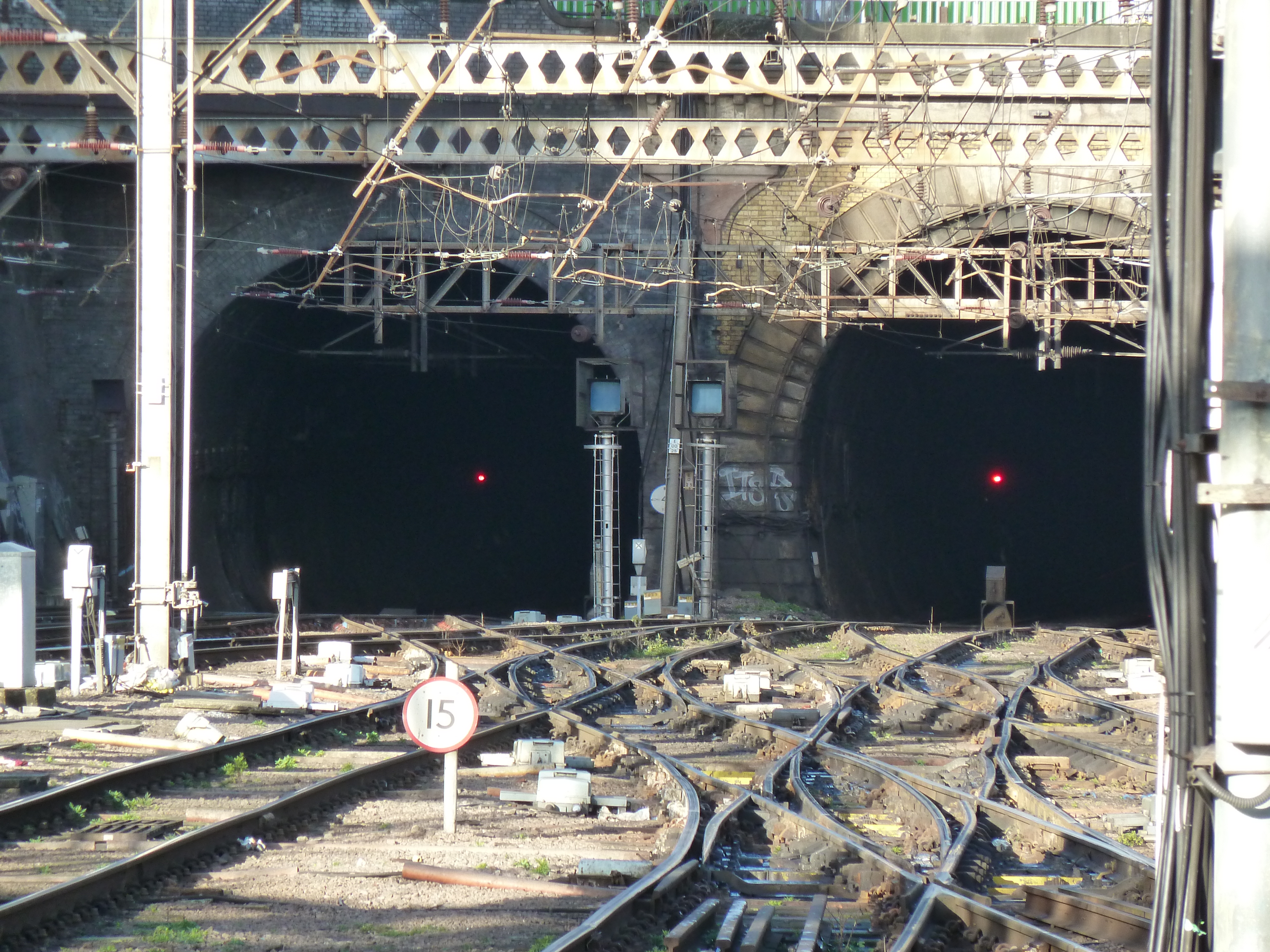
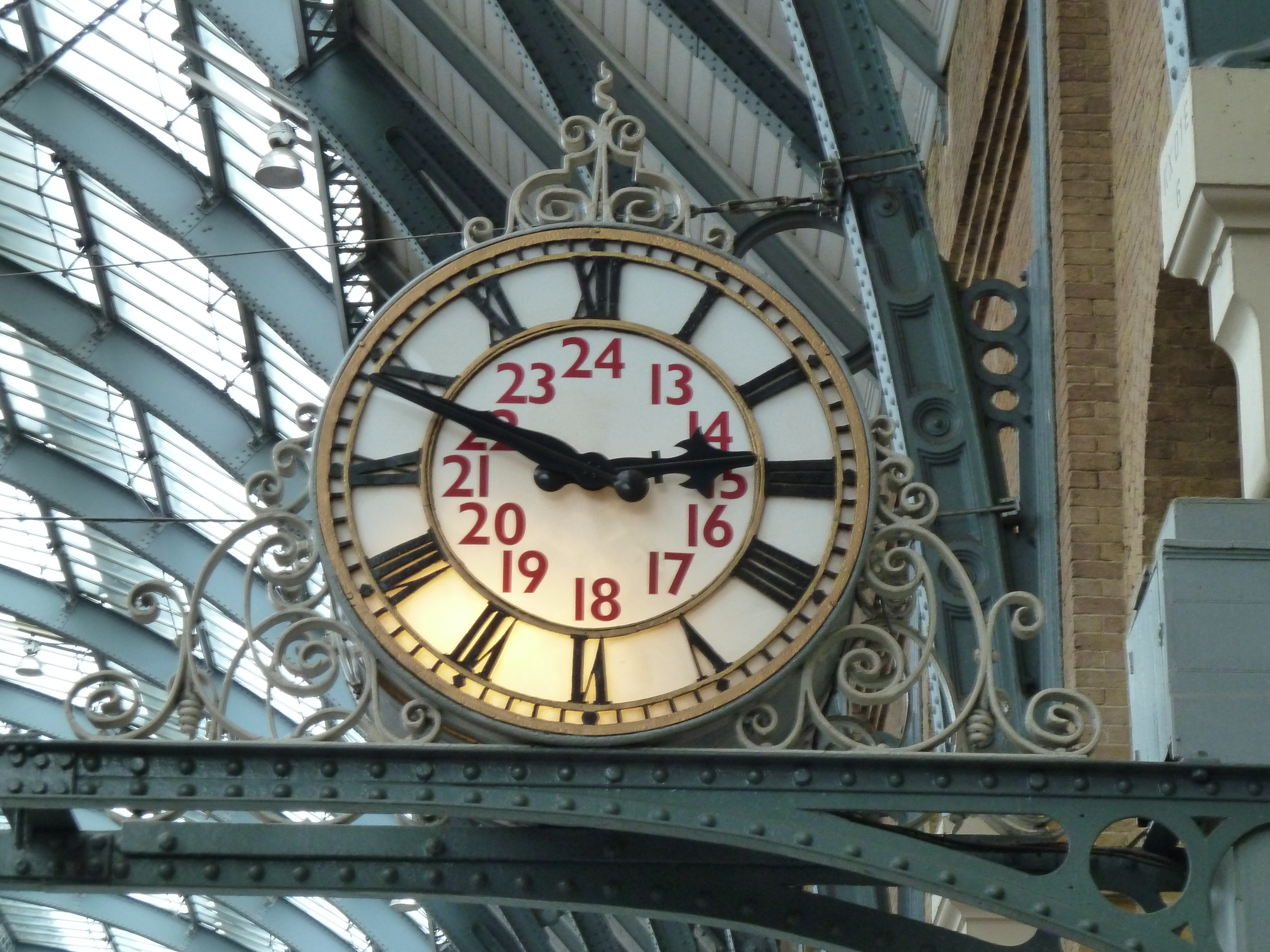
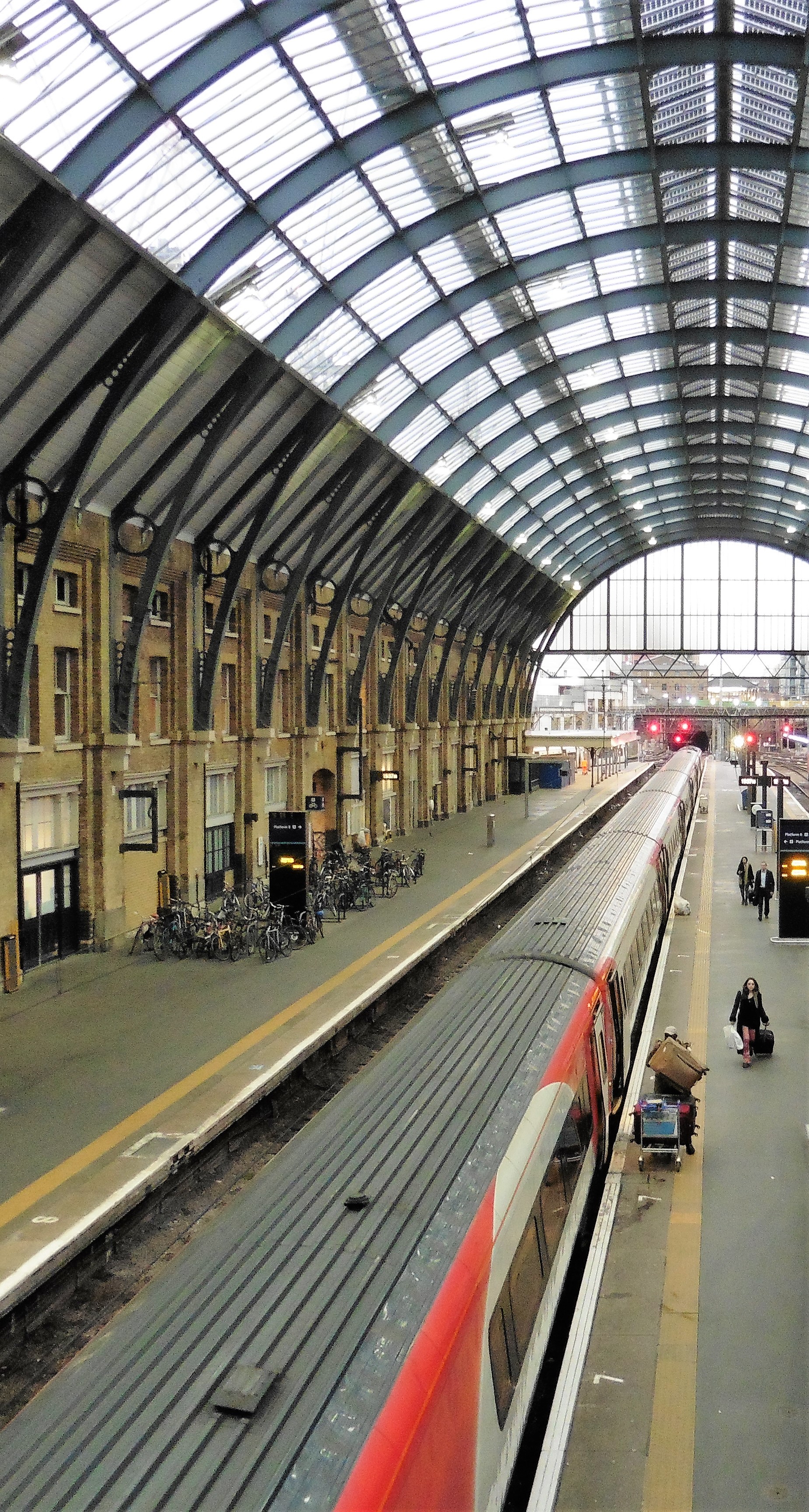
A view to the train sheds from the end of platform 10The view from island platform 4 and 5, showing the train shed, the centre brick column being obscured by the light fixture.The gasworks tunnels.A view down roads 1 and 2, notice platform 0 to the left.Clock situated on platform 1A view down to platform 6The fantastic canopy over the new concourseThe canopy. Note original station building behind.The Harry Potter shop – the photo opportunity “Platform 9 3/4” is immediately right of this, and is always busyThe fantastic exterior, with the square in the foreground
Here is a video, also taken on the day, from my YouTube site :
Please also visit Rainham Rail Enthusiast on my Facebook page.
Please also visit Rainham Rail Enthusiast on my Instagram Page.
Well, as 2018 comes to a close, just a quick blog on where I see myself going next year.
My main project, which may span over into 2020, is a comprehensive overview of all London Termini. As you can imagine, this will be a major undertaking as I need to fit it in with other personal and work life, but I am willing to put in the effort to make this overview as good as possible. My First two should be St Pancras International and Kings Cross. This series will also be covered via platform videos on my YouTube Channel
Other blogs to include more on the SouthEastern rolling stock history, and more in the series of stations I have visited – both local and far. Plus Mistydale model railway is getting a new section!
I also aim to blog at least twice month, and will set up schedules to try to meet these deadlines more accurately.
I may blog before the end of the year, but if not, expect a new post around 1st Jan 2019.
The advent of High Speed 1 to link London with the Channel Tunnel would not only mean faster services for the Eurostar, but also could enable the population of Kent to enjoy a new faster way of travel. As early as 2003, formal approval was given to allow domestic High Speed services on High Speed 1. The award in 2006 of the 2012 Olympics to London further enhanced the need for such a service to exist.
Hitachi won the right to supply the new High Speed stock to SouthEastern Railway, their first rail contract in Britain. In total 29 were built. The service to be provided meant that the trains had to be “duel electric”, to accommodate both 750 DC third rail and 25 kV AC overhead lines. The third rail extends from Ashford to Folkestone, then onwards through the Medway Towns and finally Ebbsfleet International, where the 3rd Rail shoe is retracted and the Pantograph raised (or visa-versa).
The train is based on the 400 series “Mini Shinkansen”, and comprises of 6 carriages, which can be driven from either end. The front nose of the train can be retracted to allow automatic coupling to another 6 car unit. Power is through the middle four cars, powered by pantographs/shoes on the outer two cars. Each 6 car train has 340 seats and two toilets, one of which is disabled accessible.
Additional training had to be given to train crews, to enable them to understand the TVM 430 signalling display system which was in use on the High Speed portion of the line. This is a lot different from the UK rail signalling, mostly as it is “In Cab”.
Services started fully in December 2009. During the 2012 Olympic Games, many services were run in 12 car formations, and a regular shuttle service was established from Ebbsfleet International to Stratford International, the home of the Olympic Park. In 2015, a circular route from St Pancras to St Pancras was introduced.
The trains are designed to travel at 140 mph on the High Speed section, but are limited to 70-90 mph on the old mainline from Ashford through Margate, Medway then to Ebbsfleet. They are exceptionally comfortable, and have benefitted from being fitted with dampers to reduce the effect of excessive wobble in the High Speed tunnel sections.
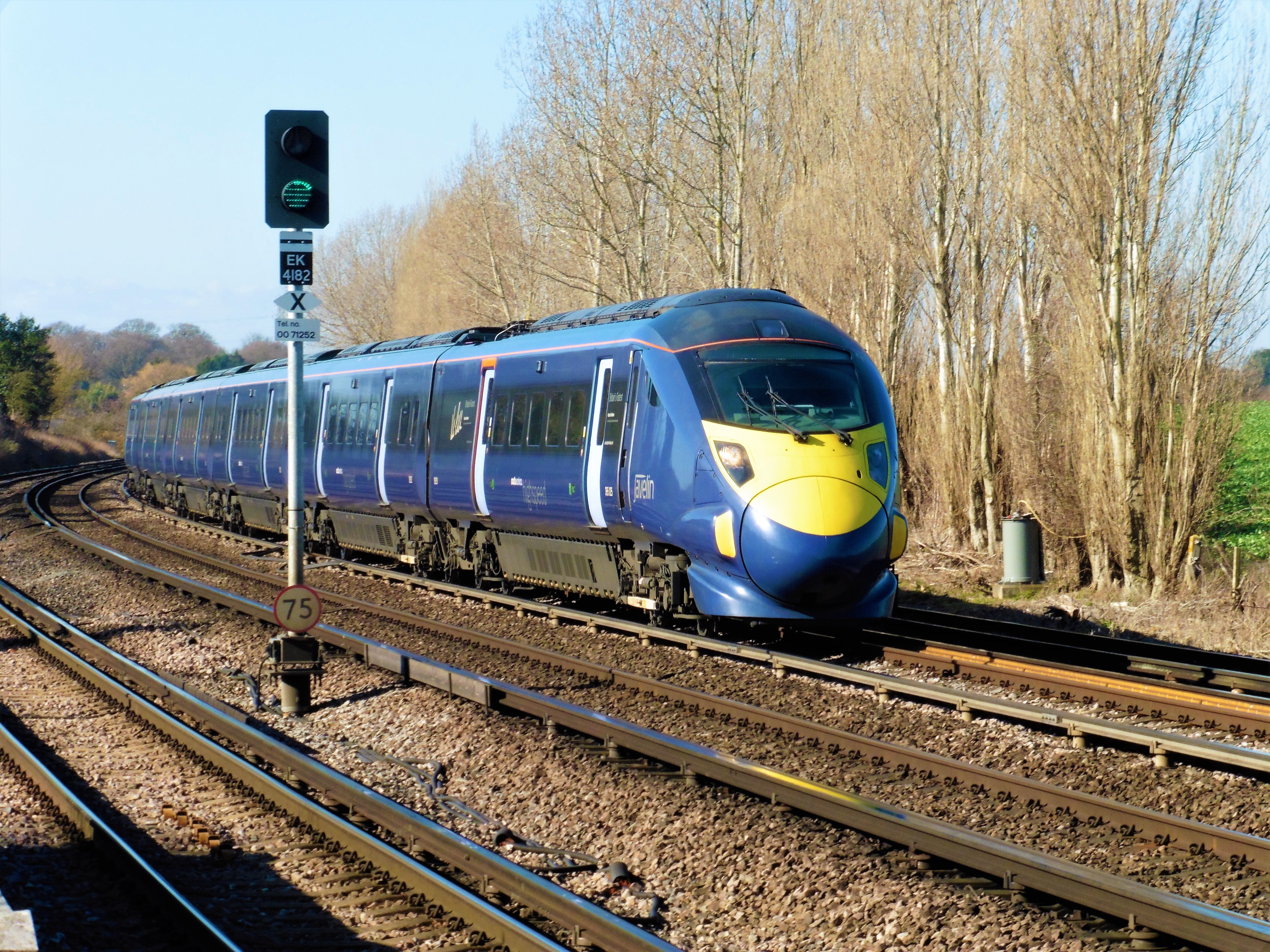
The train was given the designation of class 395, but due to the Olympics quickly gathered the nickname of Javelin, which was then established across the fleet. Initially, 11 of the Javelins were named after British Olympic medalists by public vote. This increased to 23 after the 2012 Olympics, with some named after Paralympians. Other noted named Javelins were 395014 “The Victoria Cross” (later 015) and 395016 “Somme 100”.
In 2018 to commemorate the 100 anniversary of the end of World War One, 395018 had special vinyl’s applied. These can be seen below on 11/11/18, a day after a special railtour had taken place through the south and east of the UK.
As of 2018, they continue to be the flagship of the SouthEastern railway network, and are very heavily used, even if they have a small premium applied to the ticket price.
In September 2018, I visited Didcot Parkway Railway Station, on the Great Western Main Line. A two fold visit actually, as I also visited Didcot Railway Centre on the same day. I had wanted to come to this Station for a while, as I had seen on videos that the views were fantastic, and I must say I was not disappointed.
Opened in 1844, just named Didcot, the station was a major hub for the Great Western, with connections available to Oxford (the main reason for the station at time of opening). There was also a line from here to Newbury and Southampton, however this was closed fully in 1967, passenger services being withdrawn some 5 years earlier. The oxford line (known as “The Cherwell Valley Line”) still operates, and is accessed by the station as well as the “East loop” for through trains.
The imposing Didcot Power Station is seen looking to the west. A loop for coal trains used to be in regular use, however after the closure of Didcot A, these ceased in 2013. Much of the track for this loop has now been lifted, to facilitate construction of new warehouses.
The station was given a new station building in 1985, as well as a 600 space car park. The station was renamed “Didcot Parkway” at this time.
A major redevelopment occurred in 2012, giving better access for disabled passengers, new CCTV and lighting plus better drainage on site.
Facilities here are the usual toilets, as well as lifts and a small “Pumpkin” Café which although well stocked, lacks a big seating area.
Services are plentiful. Trains “down” to the West country stop on Platform 1, whilst fast services “up” to Paddington leave from Platform 2. Platform 3 carries primarily trains to Oxford, and Platform 4 carries the trains from Oxford to London Paddington, on a stopping service. Platform 5 is used if Platform 4 is blocked for any reason, or for terminating trains from Paddington.
To the East of the station, extensive views can be had. The “East Junction” is also visible here.
A view to the west from platform 4 shows the covered area housing the café on platform 2-3. The construction work here is to lengthen the station platforms to accommodate the longer class 800 trains, which are replacing the HST’s on the routes to the west. Didcot Power Station is seen to the right in the distance.
Passenger traffic is served by the new Class 800 “IET”, HST, 387’s and 165’s. Vintage locos may also be seen leaving and entering Didcot Railway Centre , although these will most probably not be timetabled movements.
Freight is a regular sight at Didcot Parkway. Intermodal services run regularly through the station, as well as other freight heading to and from Oxford using the “east” Junction. These operations are mainly class 66, although the occasional class 70 or even 59 may be seen. Some freight may pass though or be temporarily stabled at Foxhall Junction.
All in all it was a great visit. Lots of different traction, the only downside was the weather, which was overcast, windy and eventually drizzly. However, the station is a fantastic place for photography and videography. I will return within the next couple of years, hopefully this time in the sunshine. Below is a video taken on the day.








 Rainham Rail Enthusiast