Banbury – Gateway To Almost Everywhere!

In the June of 2017, I visited Banbury Railway station, with a short trip to Heyford.  I had seen many videos from the station with its varied traction, but mainly wanted to see the Chiltern Railway services from London Marylebone to Birmingham,  some of which are class 68 / 67 hauled.  The day certainly didn’t disappoint.

Firstly a little history.  Banbury Railway Station opened in 1850 as Banbury Bridge Street Station, for the GWR.  At first it was just a single line station, but due to popularity was increased to double track a few years after opening.  Goods loops were also installed around the station, notably adjacent to the “up” line.  This also provided access to the LNWR route via another Station, Banbury Merton Street.  Further terminating bays and goods loops followed, cementing Banbury’s importance in the rail network.  In 1948 during nationalisation, the station was renamed Banbury General.

Banbury Merton Street closed in 1960, and with that Banbury General was renamed Banbury.  Some, but not all, of the goods loops around the station have subsequently been removed, and the station now has 4 lines, served by three platforms.

Many freight services pass through Banbury, mainly intermodal workings from/to Southampton.  Below are two images of Freightliner 66 501s working on the “Up” line from Southampton docks towards London.

fl again3fl again 2

The main current (2018) passenger services are as follows :

Chiltern Railways:

3 tph to London Marylebone 
2 tph to Birmingham Moor Street, 1 of which carries on to Birmingham Snow Hill

Cross Country:

Services to Bournemouth, Manchester, Reading and Newcastle

GWR

Cherwell Valley line services to Reading and Didcot Parkway

As you can see, it really is a gateway across a good part of the country!  The two pictures below are of Class 68 locomotives, on loan from DRS, on services to London Marylebone (top) and Birmingham New Street (bottom) for Chiltern Railways.
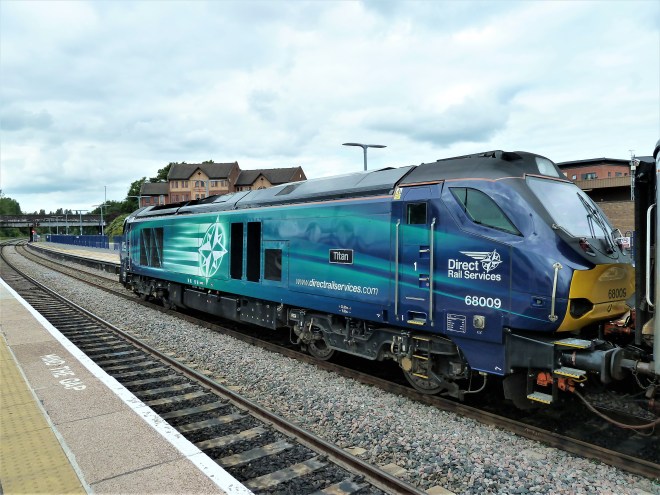
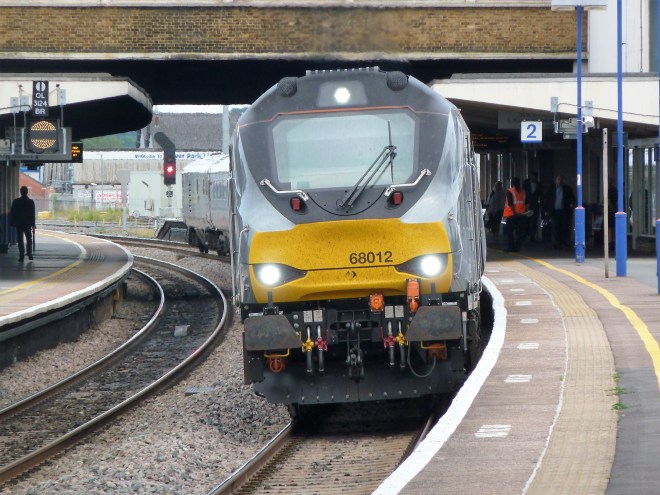
68 368 5

And here are a couple of Cross Country Voyagers, en route to Manchester and London respectively.

double vomit comet

I have also posted a video to my YouTube channel, and this can be seen below:

The station staff are friendly and are ok with photography / video work, obviously with the rules of the railway always being adhered to.  I really enjoyed my visit here, so much going on with all different types of traction, and hope to visit again in the future.


Please also visit Rainham Rail Enthusiast on YouTube

Please also visit Rainham Rail Enthusiast On Instagram

Please also visit Mistydale Model Railway On Facebook


That’s all for now, thanks for reading, I’ll blog again soon.
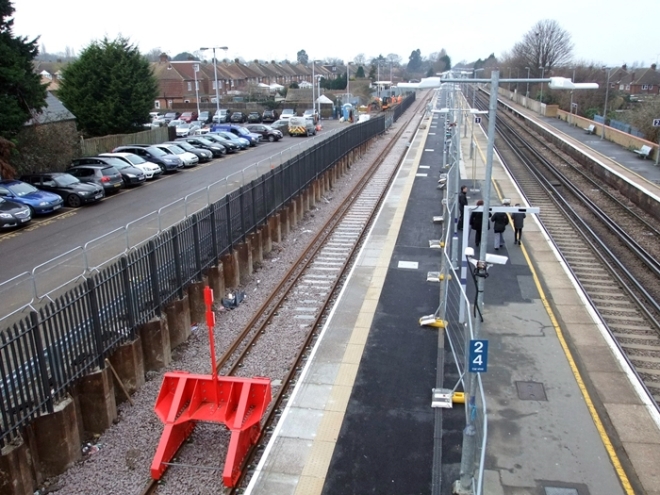
Stations Near Me – 1 – Sittingbourne

As a companion to my ongoing series of potted station histories in the Medway area, this blog subsection will concentrate on other stations near to where I live in Rainham (Kent). The first is Sittingbourne.

Sittingbourne station opened on the 25th January 1858, as part of the East Kent Railway (later to be merged with the South Eastern railway to form the South East and Chatham Railway). At this time, trains would terminate at Chatham and a horse and cart would transfer passengers to Strood, where they would join passengers on the South Eastern Railway.

The large and impressive station building is situated on the “up” line, with 2 platforms, the “down” side connected by a subway. Goods sidings at this time were adjacent to the “up” line, to the east of the main station building. In 1860, services to Sheerness-on-Sea commenced via a new line next to the existing down platform, making this platform an island type.

In 1899, a new footbridge linked the two platforms, complementing the existing subway. It was around this time that the station was also re-named “Sittingbourne & Milton Regis”, a name it was to retain until changed back to “Sittingbourne” in 1970.

The Southern Railway took over in 1923, The goods sidings on the “up” line were removed around this time. In its place, a small goods yard was installed to the side of the “down” platform. Serving primarily the paper mills, it also provided stabling for chemical trains going to Sheerness Steel in the late 20th Century.

Electrification at Sittingbourne came quite late in 1958 (the lines further west through Gillingham had been electrified since the late 1930’s). With electrification, the old semaphore signals were removed, with full electric light signals put in their place.

In recent history, a new bridge to the east of the station building was opened in April 2012. This included a lift for passengers. This was a great improvement on the situation before that, which required passengers who needed assistance to be taken across the tracks via a walkway with a member of station staff. A full refurbishment to the toilets and station building was also undertaken at this time, as well as new platform shelters. The subway was blocked in the early 2000s.

The station building is the oldest piece of railway architecture surviving in the area.

Incidents:

Three major incidents have occurred either in or near the station:

1861 : A derailment just outside the station causing 1 death.

1878 : A collision within the station as a passenger train ran into static goods vans. The fault for this was attributed to the goods shunter. 5 People died.

1966 : 18 vans of a freight train de-railed just past western junction on the “Down” approach to the station. This caused extensive damage to the infrastructure and closure of the entire line for two days. Thankfully there were no casualties.


Some information contained is this blog was obtained from the KentRail Sittingbourne Page .

Photographs (c) David Glasspool and Stacey Harris


Videos I have taken can be found on the RainhamRailEnthusiast YouTube Page.

My model railway has a Facebook page, click to view Mistydale Model Railway .

You can also follow me on Instagram : @RainhamRailEnthusiast

and Twitter : @RainhamRail


Many thanks for reading this Blog instalment – goodbye and I’ll Blog soon.

Sheerness-On-Sea Railway Disaster 1971

In this blog, I will write about the railway accident which occurred on 26th February 1971 at Sheerness-on-Sea railway station.  All relevant links to content are at the foot of this blog.

On the evening of 26th February, the 17:16, 10 car train from Victoria to Sheerness entered the station but failed to stop and the first carriage ended up careering into the station, demolishing most of the booking hall.  Unfortunately 1 person died and 13 injured, including the driver.  A more detailed look at the accident is contained below.

The train itself was a 2-HAP built for the Kent Coast line between 1958 and 1963.  This particular train comprised of 5, 2-car trainsets, all steel construction on standard BR bogies.  The power to these trains was via a controller in the cab which requires it to be depressed at all times in order to take power.  If this handle is not depressed, the brakes will apply automatically, with around a 2-3 second delay.  This so called “dead man switch” still applies today, in various forms.

As noted by various eye witnesses, many of whom were railway staff, the train appeared to slow correctly when entering platform one, but was seen to be going too fast as it ran along the platform.  Indeed one eyewitness – railwayman M.Gordon remarked to a colleague “that train is not going to stop”.

A few seconds later, the leading cab ploughed into the platform 1 buffer assembly, at what is believed to be around 10-15mph.  The upper portion of the front coach detached from the bogie assembly and carried on over the concourse, demolishing most of the ticket office and taking out a centre beam before crashing though the front of the building and coming to rest.

The fatality was a Mrs Joyce Carr, who had just bought a ticket from the office.  The 13 other injured were taken to Medway hospital, including a near term pregnant woman who gave birth 2 hours later.

The Official Report states the following conclusions to the accident.

The driver – Mr Rothwell, had suffered a head injury at Holborn Viaduct a year earlier, in which he was unconscious for around 8 minutes.  After extensive testing and evaluation, he was passed fit to drive again July 1970, and re-examined in October the same year.  Another test was planned for April 1971.

Mr Rothwell when interviewed stated that he remembered applying a slow brake to the train when entering the station, but that the next thing he remembered was being slumped over the cab after the accident.  This was in agreement with at least two other witnesses who found Mr Rothwell in the cab afterwards

The overall conclusion is that the driver had blacked out, slumping over the controls, thus still providing the connection with the controllers Dead-Man switch.  The train carried on at 10-15 Mph, before connecting with the buffers. This caused immediate application of the emergency brake, slowing the rest of the train.  Indeed, only the second carriage was further damaged, most of that ending up on the detached bogie of the leading carriage.

Following the disaster, the station building was demolished, and a new one built to the side.

The following are links to the original source for this blog:

KentOnline – Sheerness train crash remembered

Sheppey Website – Sheerness train crash

KentRail – Sheerness-on-Sea

Runaway Train – YouTube Video (c) Graham White

Official MOT Report 1971


If you are interested in Sheerness on Sea railway station, I created a vlog there in 2021 :

Please visit my YouTube channel – Rainham Rail Enthusiast for videos of modern and vintage railway action.

Many thanks for reading – I’ll blog again soon.

Medway Stations 3 – Chatham

Part 3 of my small potted history of my local stations contained within the Medway area.

Chatham station on its current site opened on the 25th January 1858 by the London, Chatham & Dover Railway.  This only took the line towards Faversham initially.  The station at this time comprised of 3 running platforms, one serving the ‘down’ line towards Faversham.  The other was an island platform serving 1 ‘up’ line and the other serving trio of loop sidings.  Above the lines, a road bridge crossed, which has stairs down to the platforms and the station building, at this stage at platform level.

The station is situated in a tight cutting, and flanked either end by the Chatham and Fort Pitt tunnels.

Full running from Victoria to Ramsgate was realised from 5th October 1863.  Around this time a major remodelling of the station took place.  The main change was the addition of a main booking hall over the tracks on the road bridge, and the demolition of the original booking hall on the platform.  The sidings were mostly removed at this time, however two still remained adjacent to the ‘up’ and ‘down’ platforms respectively.

Electrification arrived in July 1939, including electric lighting to the platforms.  The mechanical signals were removed in 1959, replaced by 3 colour aspect signals, controlled from the new power box at Rochester.  Two years later, new buildings on the ‘up’ platform were completed and the station has not really changed since, except the replacement of the signals during 2013-2017.

For more detailed information on Chatham Station, head to Kent Rail Website.

To view my railway videos please visit Rainham Rail Enthusiast on YouTube.

I also have an Instagram account.

Many thanks for reading, I’ll blog again soon.

WW2 – Upchurch railway disaster

A short re-telling of a local story.

On August 16th 1944, a V-1 ‘doodlebug’ rocket was chased by a Spitfire pilot from Dover.  After many unsuccessful attempts to shoot it down, he eventually managed to tip it with his wing, but unfortunately instead of landing in an empty field, the missile landed under the bridge of the railway line at Oak Lane, Upchurch.

It was found that a railway worker sheltering under the bridge was killed instantly.  The bridge was totally demolished in the explosion, and unfortunately the 1535 Victoria to Ramsgate was speeding towards it, having just left Rainham.  Despite the best efforts of the driver, the train encountered the now demolished bridge.  Amazingly the main cab jumped the gap but the tender fell into it and the first few carriages were heavily damaged.  In fact the 4th coach ended up straddling the gap completely.

In total 7 passengers lost their lives, they came mainly from the from the front two carriages.  Many were severely injured, and were taken to several nearby hospitals.  Miraculously the driver and fireman survived.

Being as this was the mainline through to the coast and up to London, after the investigations and clear up were completed,  a new bridge was constructed in November 1944 at a cost of £3,800.

Please also visit My YouTube channel for railway related videos, including Mistydale Model Railway .

Many thanks – I’ll blog again soon.

Medway Stations 2 – Gillingham

Continuing the potted series on my local stations, the next one on the ‘up’ line from Rainham is Gillingham.

The station was originally opened as ‘New Brompton’ in January 1858, the main station building being situated on the ‘Down’ platform, being similar in structure to the one at Rainham.  This was demolished in 1973 and replaced by prefabricated buildings, housing staff accommodation.

A goods yard was provided on the ‘down’ side, to the east of the station. This had two eastward-facing sidings, one which ended behind the ‘Down’ platform. The second passed through a 45ft long goods shed.  In 1877, after an act of parliament the previous year, a branch line to the north was provided to gain access to Chatham Dockyard.  This passed through a cutting and over a bridge, terminating at the Dockyard.  It was around this time that a substantial goods shed with 3 lines was placed adjacent to the ‘up’ line to the east of the station.

In 1912, the name changed to “Gillingham”, and a year later the first of many re-models started.  Firstly the addition of a third set of rails next to the “up” platform, creating the now familiar island configuration of the ‘up’ platform.  The “A” signal box was next to the up platform.  This remained in operation until the early 1970’s.

The Gillingham “B” signal box is next to the level crossing, and also at this time the footbridge beside the level crossing was built.  The spur to Chatham Dockyard was situated to the west of the crossing, branching off of the ‘down’ line.

An extension to the electric section of railway, from the already electrified section as far as Swanley, was agreed in 1935.  This would bring third rail operations as far as Gillingham, and the works were completed in 1939.  As previously talked about in the Rainham section, it would be almost 25 years until the rest of the south and south-eastern network would be electrified.  An EMU (Electric Multiple Unit) depot to the east of the level crossing was established, and EMU stabling commenced shortly after, something it continues to do today.

The 2nd station building, situated on the bridge over the railway, remained until a major reconstruction in 2011, when a new glass façade was built.

In the early 1990s, a scheme centered around the “Networker” program meant a new building was built to the west of the level crossing signal box on the ‘Up’ side.  This building was meant to contain a new signalling centre, however after its completion in 1994, the building remained empty, only to house a railtrack archive centre.  Eventually though, due to the start of the ‘East Kent Re-Signalling Scheme’ in 2012, the building was fitted out with equipment.  It is now the main signalling hub for the North Kent area, with only a few signal boxes on the fringes of the area operational (including Folkestone and Minster).  It is known as the ‘North Kent Operations Centre’.

Videos of the rail network can be seen on my YouTube Channel

Many thanks for reading and stopping by, I’ll blog again soon.

Medway Stations 1 – Rainham

A small potted history of the Railway stations in my home area, Medway, Kent.  I will start with my “Home” Station, Rainham.

The station was opened on 25th January 1858, as “Rainham & Newington”.  It formed part of the London to Dover route of the “East Kent Railway”.  The Station comprised of two platforms and two sidings adjacent to the “up” line platform (for those new to railway terminology, the “up” line is towards London, and the “down” away from London).  The station was re-named “Rainham” in1862 when Newington station was built to the east.  A further 400 yard siding was introduced beside the “down” platform in 1897, and a signal box was also added at this time, enabling the removal of the manual point system.

Ownership by the Southern Railway commenced in 1923.  This was to bring a few cosmetic changes to the station furniture, as well as a footbridge next to the level crossing to the east.

The next major change would not come about until 1957. The “Kent Electrification Scheme” was initiated in the area throughout what was now known as the “Chatham Main Line”. This comprised on a 750V third rail system, with line speeds up to 75mph initially, although this was raised to 90mph around 1962.The advent of British Rail meant changes for Rainham, many not very good.  The major change was the demolition of the original station building, which was replaced by a one story prefab.

New automated level crossing gates were  installed in December 1972.  At sometime in the early 1980’s the remaining siding was removed from behind the “down” platform.

When “Network South East” took over in 1986, the station was revamped in the familiar red and white chevrons, and in 1990 a new station building was opened.  This one was a modern brick structure with a glazed arched roof, and was a vast improvement on the 1970’s prefab.

As part of the 2014-2017 “East Kent Re-Signalling Project”, it was decided that Rainham would have a bay platform added adjacent to platform one on the “up” side.  This involved lengthening platform one considerably to accommodate 12 car trains in this new bay, which was given a designation of “Platform 0”.  New pointwork to the west of the station was installed to service the platform, and new SPAD (Signal Passed At Danger) signal was placed at the eastern end of platform 1.  The new platform arrangements are seen below, facing to the west with the new platform 0 to the left of the picture :

Rainham_Bay_Platform_1

The future of Rainham Station is bright.  Since 2009, “Javelin” 395 units have stopped here, giving access to high speed services to St Pancras International.  In 2018 a Thameslink service started from the bay platform to Luton via Abbey Wood and St Pancras.  This will enable passengers to access the new Crossrail “Elizabeth Line” via Abbey Wood.

A video I have taken of  37 800 travelling through Rainham Station can be found on my YouTube channel, just click the link below :

37 800 passes through Rainham Station

Thanks for reading, I’ll blog again soon.

High Speed 1 – Phase 2 10th anniversary

The 2nd phase of the HS1 line was completed 10 years ago today (14th November), so here is a small history of this section, which I personally benefit from.

The 1st phase of HS1 was completed on 28th September 2003, and connected the Channel Tunnel to Fawkham Junction, located just past Gravesend.  This junction acted as a way to get Eurostar trains on and off the existing rail network, and these trains would then terminate at Waterloo.  However planning had always been in place for a further section of high speed rail which would terminate at St Pancras.  The award of the Olympic games to London hastened the need for the completion of this further section.

Connecting with the existing High Speed line, a new station, Ebbsfleet International was constructed.  This was in preference to a new station adjacent to the M2 between Chatham and Rochester, which was thrown out on environmental grounds.  Further up the line, via two tunnels, a new station at Stratford was built.  This would serve the Olympic park.  Also it would serve as a connection between the high speed line and an extensive national rail and underground service at the existing Stratford Station, which is a 10 minute walk away.

The line then goes through another tunnel, eventually terminating at one of 3 new platforms at St Pancras International – next to the platforms for Eurostar services.  Although these are adjacent, you are not able to gain access to Eurostar from these platforms.

This second section of line was opened on 14th November 2007, and marked the completion of HS1.  However only Eurostar services used the line to begin with, but plans were in place to enable the residents of Kent to benefit from the new line.  A fleet of high speed trains were built by Hitachi in Japan.

The design of these was based on Hitachi’s 400 series “Mini-Shinkansen” and “A-Train”, and were given the designation of a class 395 unit in the United Kingdom.  However the more common “Javelin” name is used for the units, which was given to them because of their affinity with the London Olympics.  The trains were built in japan and shipped to Southampton for final fitting.  In all there are currently 29, 6 car sets currently running on the Southeastern / CTRL HS1 network.

The trains are 6 car, with 340 seats per train.  A quick coupling system allows running of two sets at once, and this was used for almost all of the shuttle trains between Ebbsfleet International and Stratford International during the Olympics.  This configuration is also expected to be used more widely in the future, as all domestic stations on the route have been changed to accommodate 12 car trains.  This includes the new station at Rochester, and the new platforms at both Rainham and Strood.

The new “Javelin” began full service on December 13th 2009, and although initial take-up was slow, it is now a very busy service, both on the Ashford and Kent coast Via Medway routes.  A “Roundabout” service which officially runs as “St Pancras Intl to St Pancras Intl” runs from London, through Medway to Ramsgate and Folkestone, then up through Ashford and up to London.  To Avoid confusion, the route is however split up into sections on route boards at stations.

The Journey times between Kent at London have been cut by up to 45 minutes between Ashford and London, and the convenience of connections to the north of the country at Kings cross and St Pancras has made the line very popular.  Trains from the Kent coast via Faversham and Strood connect to the line at Springhead Junction, where the trains move from third rail to pantograph operation.

Stratford International station has been criticised for being something of a white elephant, as only the Southeastern services stop there.  Plans have been talked about for some while to bring the German ICE trains to use the route, which would stop at Stratford International.  There is however no agreement still on when, or even if, these services will start (although in March 2017, Deutsche Bahn announced they would like it to start in 2020).  The station is still well used however, and the regeneration of the Olympic Park and Westfield shopping centre enable it to still be a viable station on the network.

———————————————————————

Videos of mine relating to Railways, can be found on my YouTube channel, just search “Rainham Rail Enthusiast” in YouTube.  Thanks for reading, I’ll blog again soon.