Medway Stations 2 – Gillingham

Continuing the potted series on my local stations, the next one on the ‘up’ line from Rainham is Gillingham.

The station was originally opened as ‘New Brompton’ in January 1858, the main station building being situated on the ‘Down’ platform, being similar in structure to the one at Rainham.  This was demolished in 1973 and replaced by prefabricated buildings, housing staff accommodation.

A goods yard was provided on the ‘down’ side, to the east of the station. This had two eastward-facing sidings, one which ended behind the ‘Down’ platform. The second passed through a 45ft long goods shed.  In 1877, after an act of parliament the previous year, a branch line to the north was provided to gain access to Chatham Dockyard.  This passed through a cutting and over a bridge, terminating at the Dockyard.  It was around this time that a substantial goods shed with 3 lines was placed adjacent to the ‘up’ line to the east of the station.

In 1912, the name changed to “Gillingham”, and a year later the first of many re-models started.  Firstly the addition of a third set of rails next to the “up” platform, creating the now familiar island configuration of the ‘up’ platform.  The “A” signal box was next to the up platform.  This remained in operation until the early 1970’s.

The Gillingham “B” signal box is next to the level crossing, and also at this time the footbridge beside the level crossing was built.  The spur to Chatham Dockyard was situated to the west of the crossing, branching off of the ‘down’ line.

An extension to the electric section of railway, from the already electrified section as far as Swanley, was agreed in 1935.  This would bring third rail operations as far as Gillingham, and the works were completed in 1939.  As previously talked about in the Rainham section, it would be almost 25 years until the rest of the south and south-eastern network would be electrified.  An EMU (Electric Multiple Unit) depot to the east of the level crossing was established, and EMU stabling commenced shortly after, something it continues to do today.

The 2nd station building, situated on the bridge over the railway, remained until a major reconstruction in 2011, when a new glass façade was built.

In the early 1990s, a scheme centered around the “Networker” program meant a new building was built to the west of the level crossing signal box on the ‘Up’ side.  This building was meant to contain a new signalling centre, however after its completion in 1994, the building remained empty, only to house a railtrack archive centre.  Eventually though, due to the start of the ‘East Kent Re-Signalling Scheme’ in 2012, the building was fitted out with equipment.  It is now the main signalling hub for the North Kent area, with only a few signal boxes on the fringes of the area operational (including Folkestone and Minster).  It is known as the ‘North Kent Operations Centre’.

Videos of the rail network can be seen on my YouTube Channel

Many thanks for reading and stopping by, I’ll blog again soon.
Medway Stations 1 – Rainham

A small potted history of the Railway stations in my home area, Medway, Kent.  I will start with my “Home” Station, Rainham.

The station was opened on 25th January 1858, as “Rainham & Newington”.  It formed part of the London to Dover route of the “East Kent Railway”.  The Station comprised of two platforms and two sidings adjacent to the “up” line platform (for those new to railway terminology, the “up” line is towards London, and the “down” away from London).  The station was re-named “Rainham” in1862 when Newington station was built to the east.  A further 400 yard siding was introduced beside the “down” platform in 1897, and a signal box was also added at this time, enabling the removal of the manual point system.

Ownership by the Southern Railway commenced in 1923.  This was to bring a few cosmetic changes to the station furniture, as well as a footbridge next to the level crossing to the east.

The next major change would not come about until 1957. The “Kent Electrification Scheme” was initiated in the area throughout what was now known as the “Chatham Main Line”. This comprised on a 750V third rail system, with line speeds up to 75mph initially, although this was raised to 90mph around 1962.The advent of British Rail meant changes for Rainham, many not very good.  The major change was the demolition of the original station building, which was replaced by a one story prefab.

New automated level crossing gates were  installed in December 1972.  At sometime in the early 1980’s the remaining siding was removed from behind the “down” platform.

When “Network South East” took over in 1986, the station was revamped in the familiar red and white chevrons, and in 1990 a new station building was opened.  This one was a modern brick structure with a glazed arched roof, and was a vast improvement on the 1970’s prefab.

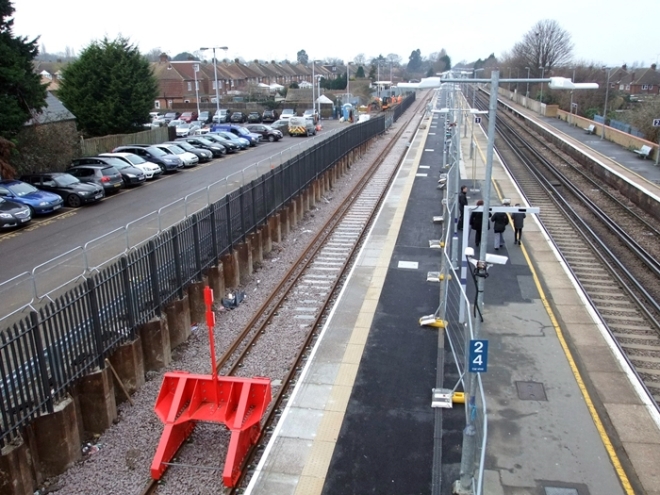
As part of the 2014-2017 “East Kent Re-Signalling Project”, it was decided that Rainham would have a bay platform added adjacent to platform one on the “up” side.  This involved lengthening platform one considerably to accommodate 12 car trains in this new bay, which was given a designation of “Platform 0”.  New pointwork to the west of the station was installed to service the platform, and new SPAD (Signal Passed At Danger) signal was placed at the eastern end of platform 1.  The new platform arrangements are seen below, facing to the west with the new platform 0 to the left of the picture :

Rainham_Bay_Platform_1

The future of Rainham Station is bright.  Since 2009, “Javelin” 395 units have stopped here, giving access to high speed services to St Pancras International.  In 2018 a Thameslink service started from the bay platform to Luton via Abbey Wood and St Pancras.  This will enable passengers to access the new Crossrail “Elizabeth Line” via Abbey Wood.

A video I have taken of  37 800 travelling through Rainham Station can be found on my YouTube channel, just click the link below :

37 800 passes through Rainham Station

Thanks for reading, I’ll blog again soon.